


In 1962 the French philosopher and literary theorist Roland Barthes penned a lively and gripping article on crime stories and what he called the “miracle of the clue”. Writing in the periodical 'Médiations - la revue des expressions contemporaines' , Barthes stated: “The miracle of the clue is that it's the most obscure clue that solves the mystery in the end.”
In 2021 if there remains a (political) mystery that the legions of editorialists and political commentators still seem unable to resolve after more than four years of his five-year presidency, it is what Presidential Emmanuel Macron really stands for – the real nature of 'Macronism'.
Enlargement : Illustration 1
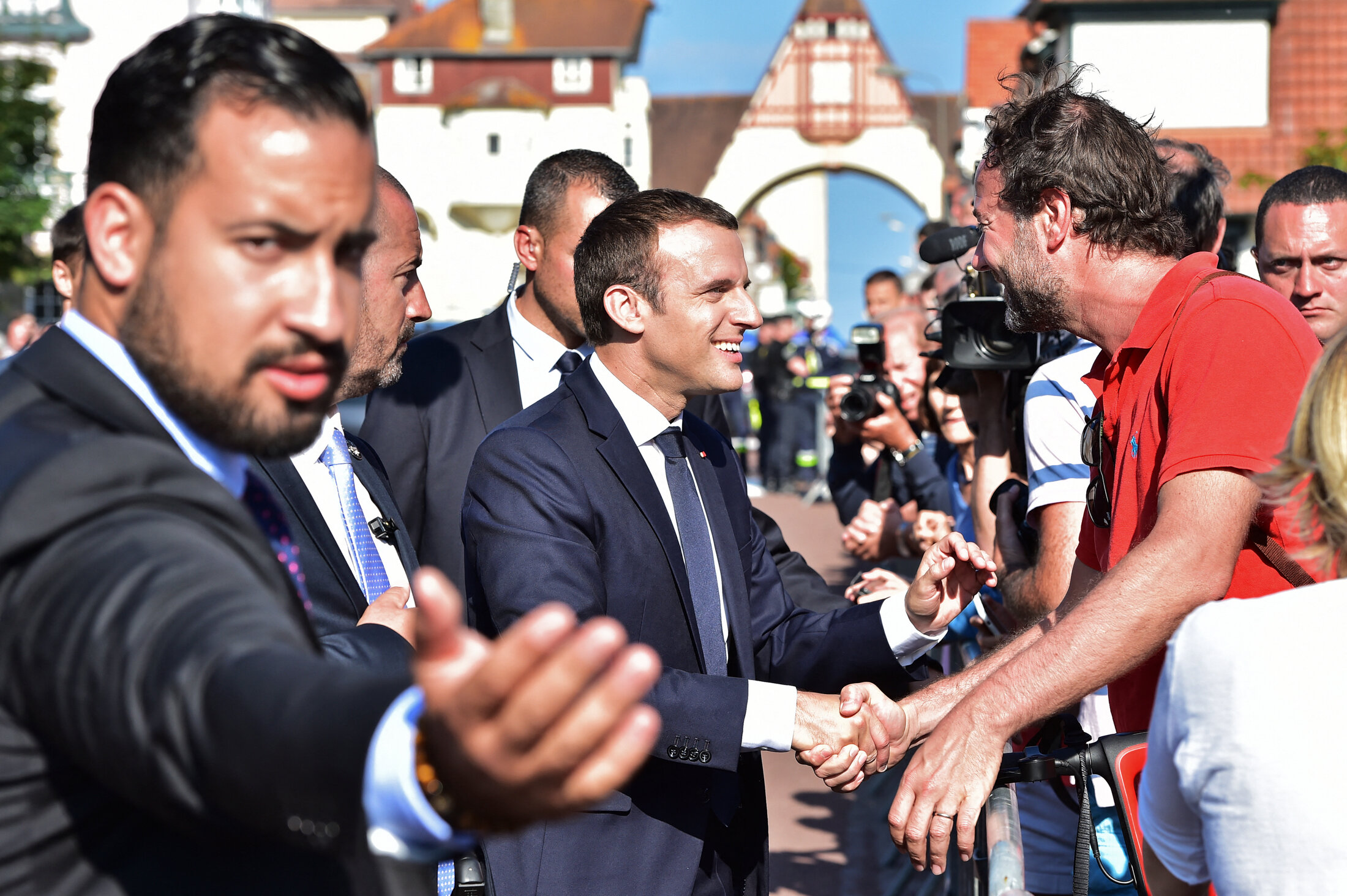
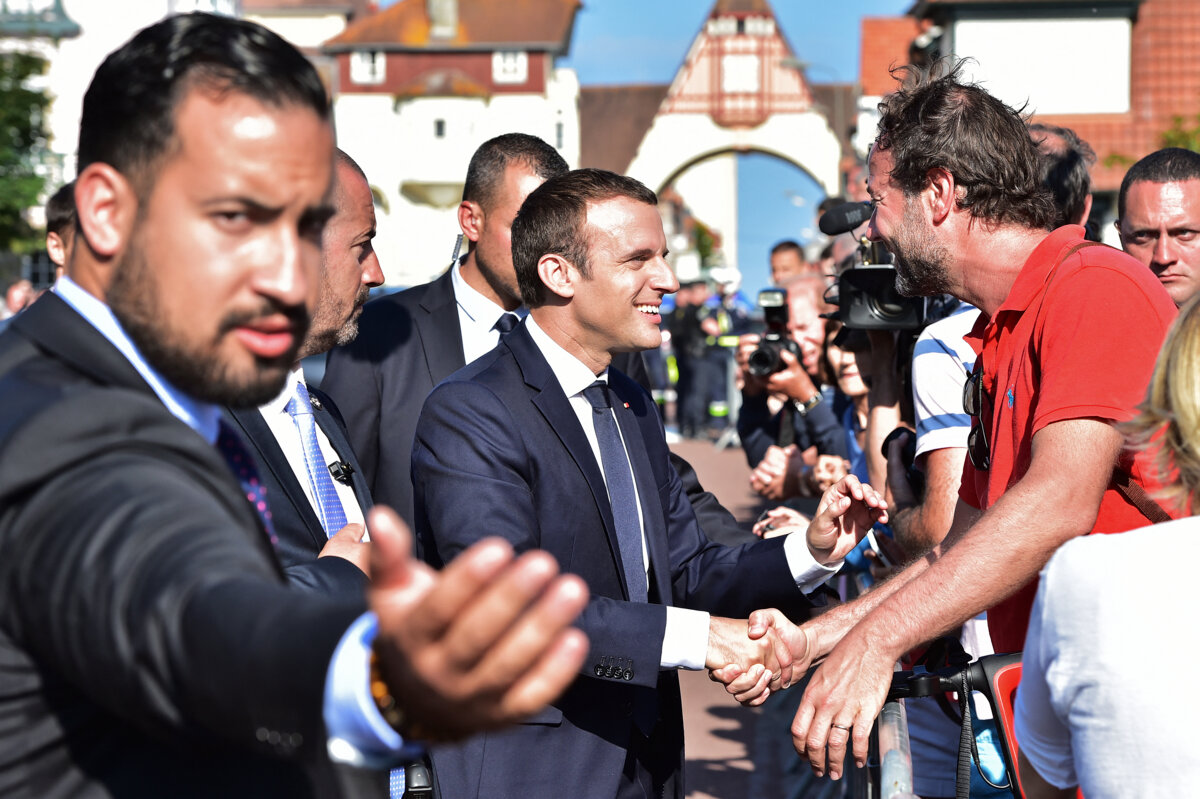
Yet there is one news item (which was also political in nature) – the violence carried out against protestors on May 1st 2018 by Macron's bodyguard Alexandre Benalla whose trial started on Monday September 13th – which has at least begun to help us to resolve this political mystery. For the bodyguard's actions led to a profound revelation in the summer of 2018, a revelation about an often-disregarded aspect of the president: that 'Macronism' is, in some respects, populism.
The clue which, to use Barthes's expression, “solved the mystery” came in 12 short minutes. They were part of a speech that Emmanuel Macron gave in Paris at the Maison de l’Amérique Latine on July 24th 2018, just one week after Le Monde broke the first revelations about what became known as the Benalla affair. There is no official recording of the event but there nonetheless exists a relatively complete video of the speech filmed on a mobile phone.
The president was addressing both Members of Parliament and Senators from his new Parliamentary majority. Perched on a stage, the head of state was surrounded by virtually his entire government. Indeed, the array of ministers seemed to form a physical barrier with and around him at a time when the storm of the Benalla affair was raging across France, and was talked about both in the media and in people's homes. Several of the ministers present that day are no longer in government: interior minister Gérard Collomb, government spokesperson Benjamin Griveaux, François de Rugy, Brune Poirson. Others, such as Gérald Darmanin, Marlène Schiappa and Olivier Dussopt, still are.
At the time Emmanuel Macron had not yet spoken publicly about an affair which had all the ingredients of a real scandal; one of his closest aides in the presidency had disguised himself as a police officer an hit demonstrators in the centre of Paris. Yet though both the Élysée and the Ministry of the Interior knew about the incident immediately, Benalla escaped with just a token punishment. It was only after the press revealed the affair that he was sacked from his position.
What is most remembered from this speech on July 24th 2018 – and this was deliberate – is Macron's phrase: “If they want someone to hold responsible, he's in front of you, let them come and get him.” In this way the head of state was declaring himself the sole person responsible for the affair, facing up to the mysterious “they”. This form of bravado, coming from a man who because of his position as head of state was untouchable, brings to mind the actions of President Nicolas Sarkozy in 2007 when he acted like a street brawler with angry fishermen at Guilvinec in Brittany, even though he knew he was surrounded by bodyguards.
But that comment is not the issue here. In his speech Macron, who wants to govern like Jupiter, a lofty deity rising above all others, in fact showed himself to be more like Janus, the two-faced god who looks both ways. The man who as a candidate had been careful to support the checks and balances needed in any democracy, showed quite another face once he became president. Speaking as if he was the commander of a fortress under siege – as far as he was concerned the Benalla affair was designed to “tarnish the president of the Republic, shake his government and, with it, our institutions” - the head of state did not hold back from attacking what are normally seen as the indispensable checks and counter-balances of any democracy.
“What worries me,” said Macron, “is the spectacle that's taken place over several days. What I've seen for four days is a spectacle where virtually all of the powers have been tempted to rise up out of their normal domain.”
His first target was the press. “We have a press which no longer seeks the truth,” said the head of state, even going so far as to suggest that images that could have put Alexandre Benalla's violent behaviour into context had been concealed. “I see a media power which has decided to become a judicial power,” he said, appearing to forget that in this affair it was the press – Le Monde and then Mediapart – which had revealed the true facts that the Élysée had, on the contrary, worked hard to conceal.
The second target was the justice system. “I see a judicial power which is going to carry on doing its job and that's vital … but I notice we have a problem about the way it operates day to day. There's not one witness examination, not one search that doesn't appear at the same moment in the press. How can presumption of innocence work with it operating like that?” asked the president, appearing to accuse – without the slightest concrete evidence – police officers and/or magistrates of orchestrating leaks to the press with the sole aim of harming the presumption of innocence of his protégé, words which succeeded in getting applause from the audience.
His third target was Parliament. “And I see some people who want to take the legislative power away from its normal role, who consider that it's down to Parliament to take the place of the justice system and to become a court of public opinion, to forget the separation of powers,” Macron thundered. Rarely has a French president so abused the concept of the separation of powers as publicly as Emmanuel Macron did in this speech in July 2018. He gave the curious impression that this separation of powers meant the freedom for each power to do as it saw fit, hidden from the view of others.
In fact, the separation of powers is precisely the opposite of that, as has been repeated often enough on this website. Since as long ago as the 18th century we have known that to avoid the abuse of power, one power has to check another power. This even forms part of the DNA of our Constitution: Parliament is not just the place where laws are made, it is also an instrument to control the government, without which indulgence and impunity triumph.
In the Benalla affair it was indeed fortunate that there was a senatorial committee which, after months of investigation, was able to unearth the major malfunctions that had occurred at the Élysée over several aspects of the case (the events of May 1st themselves, the Russian contract that Benalla had agreed while still working there, his use of a diplomatic passport and so on).
The fourth and final target was the political opposition. “And we are seeing the bizarre coalition … of those who claim to come from Gaullism, and who have forgotten all principles and dignity, with the extremes who are at least consistent in what they seek: they don't like the state and they want to topple the Republic,” said the president. He ended his speech on a professorial tone, asking in effect the country to be well behaved: “In these circumstances, everyone should stay calm.”
Everyone is free to interpret this speech by Emmanuel Macon as they see fit. But a president is not very liberal (in the political sense of the word) when, faced with difficulties, they come out and attack the press, Parliament, the justice system and the opposition, ultimately asking all of them to watch their step.
There was also more than a touch of the 'Ancien Régime' about the way in which Macron spoke, a throwback to the time of the French monarchy, where the king would put on a show while state affairs were discreetly handled in secret.
When we look more closely we can see that as early as 2015 Emmanuel Macron had already given little clues indicating his hubris in such issues.
When Macron was still economy minister under President François Hollande he stated in a long interview with the weekly Le 1: “Something is absent from the democratic process and the way it operates. In French politics this absence is the person of the king, whom I think fundamentally the French people didn't want dead. The Terror [editor's note, a period of public executions during the French Revolution] left an emotional and collective emptiness, a void in the public imagination: the king was no more! Now, if we want to stabilise politics and get out of the current neurotic situation, we have to accept a little more verticality, while keeping the balance from the legislature.
Emmanuel Macron was giving his personal interpretation of the writings of the late philosopher Claude Lefort, whose intellectual heritage he nonetheless claims for himself. In fact, as the periodical Esprit – to which Macron has contributed in the past - reminded us in a 2019 cover article ('L’inquiétude démocratique, Claude Lefort au présent'), Claude Lefort had on the contrary said this gap left by the death of the king should definitely not be filled with an excessive reliance on personalities. Lefort said this gap should remain empty because no person can appropriate it in a democracy.
All that could come across as rather theoretical. The reality is that after the change in the presidency represented by the Benalla affair, this monarcho-populist approach to events has had an impact on how President Macron has handled public affairs subsequently. Three examples demonstrate this.
The first example concerns the police violence which has been used against social or political demonstrations, in particular against the 'yellow vest' protest movement. This has led to unprecedented serious injuries in France, such as the loss of an eye, a hand being blown off and disfigurements, all of which have been widely documented in the press. What has the president had to say about this? “Don't speak to me of 'repression' or 'police violence', these words are unacceptable in a country governed by the rule of law,” he has said, as if it were the words that were the problem and not the reality they describe.
In a quite different domain, that of the Covid-19 pandemic, Emmanuel Macron has hidden away his handling of the crisis – which has had its fiascos (masks) and its successes (vaccinations) – inside a public health Defence Council. Here, by definition, everything is a secret and nothing is transparent as he dons the twin uniform of a wartime leader fighting a virus and that of royal miracle-maker.
The third example concerns the formal investigation launched in July 2021 into Macron's justice minister Éric Dupond-Moretti over a conflict of interest – a first in French judicial history. On the eve of the announcement of this investigation the president used the weekly meeting of government ministers to mount a strong defence of his minister. “The judicial system is an authority not a power. I won't let the judiciary become a power,” the president said, according to BFMTV news channel - a report that was not denied. Once again the president displayed a distorted interpretation of the role of the institutions.
If we want to stabilise politics and get out of the current neurotic situation, we have to accept a little more verticality, while keeping the balance from the legislature.
By using the word “authority” in relation to the judicial system - as it is referred to in the French Constitution - just before one of his minsters was set to be placed under investigation, Macron revealed a very top-down conception of how judges should work. The suggestion seems to be that they should somehow be subject to the government – or in any case, should not interfere with the will of the Élysée. The only problem with this reading is that article 64 of the Constitution invoked by Emmanuel Macron states something quite different: “The President of the Republic shall be the guarantor of the independence of the Judicial Authority.”
The outcome was that, protected by the president's comments, Éric Dupond-Moretti did not resign, as would have been the case in Britain, Germany, the United States and Israel for example. And having been placed under investigation for alleged conflict of interest, the justice minister is now preparing to go to the Senate to defend a new bill whose title is 'Trust in the Judicial Institution'.
Obviously these three examples – and many others that could have been cited – are not meant to suggest that Macron is a French version of the Hungarian prime minister Viktor Orbán. But, equally, since his speech of July 2018 and subsequent events, the French president can no longer reasonably be seen as a credible barrier holding back the current drift towards populism, despite his claims to be.
Worse than that, it is not fanciful to propose that such an attitude in fact fans the flames of the far right; a far right whom Macron's supporters seem to want him to face in the decisive second round of the presidential elections in April 2022. This would, they think, make it easier for him to get re-elected. This is a dangerous game in which, one day or another, democracy will be the loser.
“I have an obligation to the whole truth,” Emmanuel Macron said at his speech at the Maison de l’Amérique Latine on July 24th 2018. We're still waiting for it.
---------------------------------------------------------------------------------
- The original French version of this op-ed article can be found here.
English version by Michael Streeter