


Laura is used to dealing with poverty. She is a primary school teacher in one of France's education priority zones, which are designed to improve educational opportunities for children in some of the country's most disadvantaged areas. Her pupils come from Les Rosiers, a deprived housing estate in the Mediterranean city of Marseille where residents live in old run-down buildings that are, even at the best of times, bad for people's health and safety. But since France's Covid-19 lockdown began on March 17th, the existing social vulnerabilities and inequalities have been exacerbated in such areas. Children are not now just living in poor housing, they are going hungry too.
“Some parents tell me they have been fasting for days, one mother is anaemic, another has no more milk for her baby who is now drinking herbal tea, while a third asked me for some salt as she is economising on everything and that costs 50 centimes [editor's note, half a euro] but she is virtually down to her last 50 centimes,” explained the teacher.
Enlargement : Illustration 1

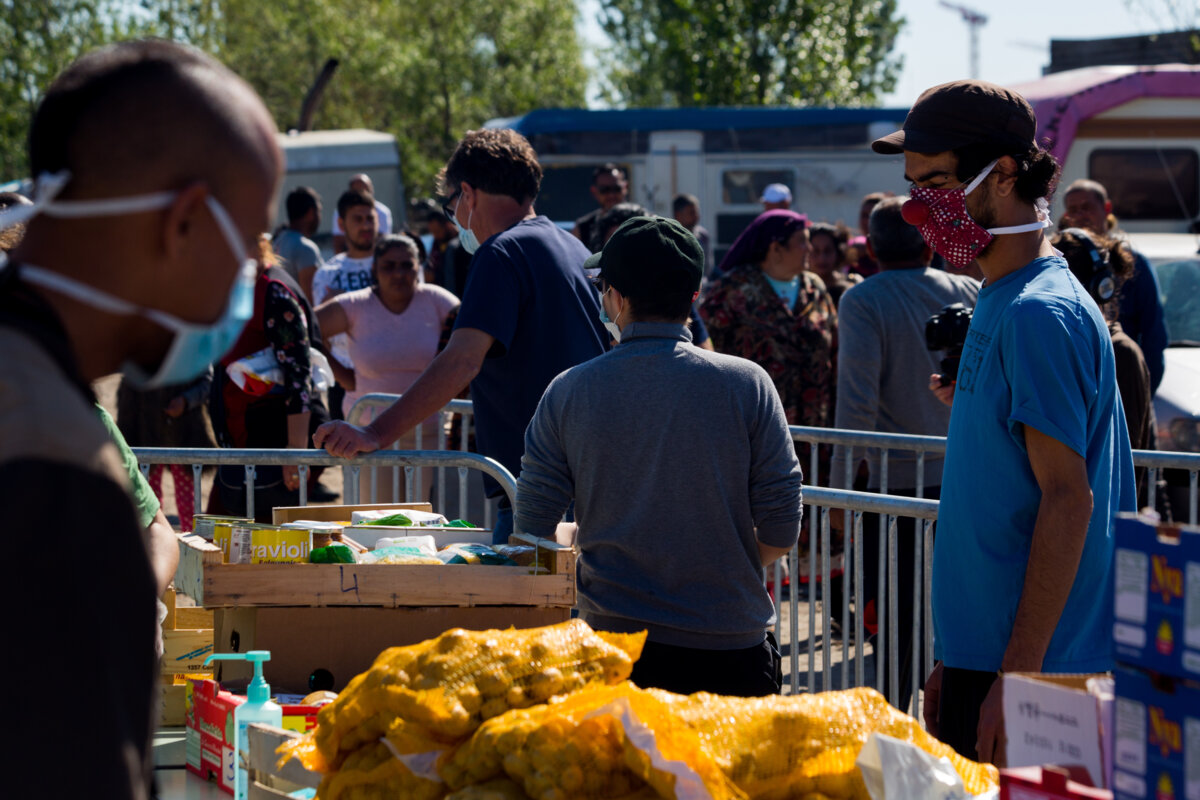
In normal times the poorest families manage to get by. They are able to feed themselves thanks to undeclared casual work. But the lockdown has brought an abrupt end to this way of existence. For the last five weeks simply getting enough to eat has become an obstacle course. Local food charities have been overwhelmed, while new local support networks have sprung up. Schools are often a source of help for the poorest families, but their closure has meant school canteens are closed too, and with them the only full and balanced meal that the children in some poor families get each day. Depending on a family's situation, this meal is often free and consists of a starter, a main course and a pudding.
Jean Merckaert, director of action and advocacy at the Catholic charity Secours Catholique, warned that the situation was now serious. “The most excluded of the excluded, people in shantytowns and campsites, those who live from begging and casual income, they are hungry,” he said. “Today the Roma are more afraid of dying from hunger than from the coronavirus.” To make matters worse at the start of the lockdown it was also harder to distribute food and other help as many of the usual volunteers are over 70 and so at greater risk from the Covid-19 virus.
Merckaert said that more and more young people aged between 18 and 25, who are often excluded from social welfare, are now approaching Secours Catholique for help. Other groups seeking help include housewives, people who work on the black on building sites and those who do not have the correct immigration documentation. These groups all live off the radar and cannot get the revenu de solidarité active (RSA) welfare payment, though some do qualify for the benefit for asylum seekers known as the ADA or allocation du demandeur d’asile. “It's tragic for them and it also shatters this hypocrisy of allowing people to be exploited without giving them the formal right to live and work here,” said the charity official. “Measures need to be taken to regularise them.”
The government has already announced that benefits offices will provide a payment for “low-income families with children in order to allow them to meet their essential needs”. This will be paid on May 15th to those families who already receive the RSA benefit or the allocation de solidarité spécifique (ASS) payment for people no longer entitled to unemployment benefit. Each family will get 150 euros plus 100 euros per child in the household. Families who currently receive housing benefit will also get 100 euros per child. In all some four million families are involved. Yet the figures show that some 9.3 million people live in poverty in France.
Jean Merckaert believes the government's actions are insufficient, as he estimates people's needs to be around 250 euros per person a month. Already, he said, some families are going without food. He cites the example of French overseas territories such as French Guiana in South America and Mayotte in the Indian Ocean where voluntary groups handing out food aid have been overwhelmed. Moreover, this help will not arrive until May 15th, which is an eternity away for people who are hungry now. “The budgetary difficulties usually encountered at the end of the month are today coming in the middle of the month,” said Secours Catholique's Merckaert. “Especially as this period is going to last beyond May 11th and the start of the end of the lockdown [editor's note, as decreed by President Emmanuel Macron, who has said that some schools should start to re-open from then.] It's not a given that all children will be returning to the canteens.”
The government's lack of response to the issues is due, said Merckaert, to the inability of public services to get organised and the tendency to pass the buck on to another government ministry. “This period of health crisis has revealed gaps in state action; from the very first days we realised that for an entire group of people the food aid networks were a survival network and when that closes, the public authorities can't do anything,” he said.
At a local level some town and city councils, such as in Lille in northern France, have been distributing food parcels to families who normally get free or heavily-discounted school meals. Other cities such as Brest in western France and Paris have announced they are putting schemes in place to help out the poorest families. Marseille, however, has been slow to react. Its mayor, Jean-Claude Gaudin, has now asked the company Sodexo, who supply school meals locally, to reopen its central kitchen to distribute 5,000 meals a day to the least well-off families.
Marie-Aleth Grard, vice-president of the French branch of the global anti-poverty organisation ATD Fourth World, and member of the scientific council set up by President Emmanuel Macron in the wake of the virus health emergency, has received warnings from across the country about the problems people are having in feeding their families. “These families are virtually down to their last few euros because it all goes very quickly during the month,” she said. “Budgets have gone up because there are no longer school canteens [editor's note, with free meals] and shopping is being done in the nearest shop which is not always the cheapest.”
Her other concern is about the closure of many post office branches which has meant that people cannot receive benefits such as the RSA. “With 1,850 post office branches open out of 7,000, some people have been abandoned. In heavily urban areas you can, if the worst comes to the worst, go a bit further. That's impossible if you live in a remote country area.”
While Marie-Aleth Grard is not surprised by the prevalence of poverty, she said that the lockdown and its consequences have highlighted the fact that millions of people struggle on a daily basis. Those who are already on the borderline of poverty find themselves in huge difficulty when a major event comes along and disrupts their lives.
“Our system doesn't work well,” she said. “The [local] networks gloss over the failings of the state. That's unacceptable, it means that these families are dependent on food handouts. You're living in the world's sixth global power and yet you can't choose what you eat and what you give your children.”
That is also the view of Sadek Deghima, who is in charge of the child social welfare prevention service at Harnes, near Lens in the north of France. He sees the ravages caused by the virus crisis on a daily basis. In this old mining area the unemployment levels are at record levels and people normally survive on temporary work or contracts, doing cleaning work here and there.
As elsewhere, the schools and their canteens are closed, and even worse is the fact that the lockdown is changing the way that people eat. Families are having to produce more meals while at the same time stopping teenagers from snacking and emptying their cupboards. Sadek Deghima has noticed a growth in the number of people using food banks in the area. This is mainly because “all those who were living in a vulnerable area and were just about okay suddenly faced dramatic change because of the lockdown. The slightest change tips them into poverty.”
Radja belongs to one of those families and harks back to pre-lockdown times when, after a fashion, she was able to get by. In January her husband was deported back to their country of origin in North Africa. She herself does not have legal status in France and so cannot get any welfare benefits. “We've no rights,” she said. “Since I've been in France I've never fallen into difficulty like this. I didn't contact social workers, I paid my rent, I always got by. But with the lockdown you've nowhere to turn.”
For several years she was a waitress in a restaurant, working on the black, then she worked in a bakery before stopping during her last pregnancy. She has since done some cleaning jobs to make ends meet, earning a few hundred euros. Since the enforced departure of her husband, who brought in the main household income, Radja no longer has a home and has gone into temporary accommodation. And since the lockdown she has felt acutely stressed.
“I don't eat anything, I'm demoralised, I've got no appetite any more, I'm too stressed,” she said. The fear of falling ill and the impossibility of looking after her children has led her to stopping all work. Now, Radja said, she is relying on support networks to feed her children.
Improvised support networks
The lockdown and its restrictions have caused Radja to change her habits. She contacted a social worker who gave her 50 euros worth of vouchers to buy food. These vouchers, known as 'Ticket Service', are supplied by local authorities. They are supposed to last her 20 days, but she said this was impossible. “Fifty euros goes quickly when buying nappies and milk,” she said. “I can't go to Lidl or Aldi because they don't take these vouchers. So I have to go to Casino [editor's note, another supermarket] where everything is more expensive. The social worker doesn't understand that it's not enough.” As proof she pointed out that she had only just received the vouchers and already all she had left was 20 euros to last her another 19 days.
She is also unhappy that she is unable to keep much control over what her children eat or give them what they want. “Before, when I was able to work, I bought them everything, I managed. Today they eat what is given to me,” Radja said. “In the [food] parcels there is such and such a brand of yoghurt, my children don't eat them, they don't understand. The 18-month-old I can fool a bit but not the others. I tell them that tomorrow I'll buy them what they want, such as Pringles, and hope that they'll forget.” The absence of school lunches gnaws into the budget because children of school age normally get a full meal at lunchtime. Now all the meals are provided at home, including the traditional afternoon snack or goûter.
Laurence is a teacher in a nursery school in an education priority zone which has 270 pupils and ten teachers. It is based in Marseille's 1st arrondissement or district and the establishment has swung into action to help the families. After the schools closed on March 16th she and her colleagues divided between them the families who were most vulnerable and called them. Initially 14 were targeted, and today 35 are being helped.
“We know them but we have discovered lots of others, not those that you'd really have thought of,” said Laurence. “Normally it's the social workers who contact us and who take over. At the start parents told us 'it's all fine'.”
Then the teacher started to get messages from mothers, messages that that came in one after another, like bottles floating in from the sea. Parents were asking if it was possible to use restaurant vouchers to buy some shopping. Laurence read between the lines and realised that their children were hungry and that their parents were not sure who else to turn to. It was also clear that the city authorities in Marseille had not put anything in place to help them.
“My colleagues and I all gave money but we quickly saw that it wasn't going to be enough with our personal funds and we waited in vain for city hall to provide food aid. Five or six of us did shopping for the most vulnerable,” she said.
The support network took a lot of organising, especially as they also had to carry on with their daily lives, working from home. Ingenuity and improvisation took over, said Laurence. “One colleague found a nice butcher who gave us some unsold chicken for ten or so families,” she said. “We also tried to find baskets of fruit and vegetables.”
'Zazi', not her real name, who is aged 39 and has children and seven and four, also lives in the city's 1st arrondissement. She has a disease which affects her immune system and because of the virus cannot work or go out at the moment, and is in complete self-isolation. Usually her husband supports the family with undeclared extra work in a restaurant. He is currently laid-off under France's system of temporary and redundancies. Though the budget is always tight, in pre-virus times Zazi was able to shop normally, though she made the food stretch for as long as possible. “I usually manage it well, I go to Lidl, I spend 60 euros there and then I buy 50 euros worth of vegetables and meat,” she said.
But now the couple, who are immigrants with no legal status in France, have no income. Zazi also said that she had been subjected to several racist remarks from a social worker who asked why she had come to France to “have a hard time”. She left in tears.
When the lockdown came Zazi did not want to seek help. But one of her neighbours, who knew how vulnerable she was, realised she needed help. “She took me to Carrefour [editor's note, a French supermarket chain] and she spent 200 euros. My neighbour got me snacks, juice and meat, she knows that I'm ill and that I must eat well, otherwise I'm too weak,” Zazi said. But eventually those provisions were used up. And the social worker was still not helping her, she said.
“I was getting stressed about what would happen to us and I was also wondering how I was going to feed the children,” she said. After a month of lockdown she had reached the limit of her resources. “The little ones were asking for cake, pizza. I had nothing to make them, not even an egg, oil or sugar,” she said. This led her to contact her son's teacher, to ask if she knew of anyone she could ask to help feed her children.
As for Laura, the teacher whose pupils live on the Les Rosiers estate in Marseille's 14th arrondissement, she was gradually starting to realise just how serious the situation had become in her part of the city. No longer able to communicate with an Arab-speaking mother at distance, though face to face they had managed to understand each other, the teacher asked her own mother – who speaks Arabic – to speak to the woman to make sure all was okay. “They started to talk,” said Laura. “And this mother, who has lost her entire income, felt comfortable with my mother and told her that she had nothing left to eat. She wasn't talking to a teacher, someone who was going to judge her or, even worse, give her worrying information. My mother told me to withdraw some money for her and to give her a bag of shopping.”
Laura did so and also spoke to a colleague. The two women drew up a list of around thirty families who might be in trouble. They started a fund because they knew they would not have the means to feed everyone. Today 120 families are being helped by this impromptu food aid network.
Laura and her colleague also approached the city authorities and officials from the Prefecture, the local office representing the state. Talks with the latter allowed them to get access to donated goods and to make contact with the director of the community centre in their part of Marseille, the 14th arrondissement or district, which then became a collection and distribution point. They also asked the Fondation de France – a major philanthropic network in France - for a grant and made contact with bodies such as the Red Cross and the food charity Restos du Cœur.
The food parcels they hand out are “the equivalent of a shopping trolley” and include fruit and vegetables but also some chocolate to bring a little pleasure into daily life. “We want the recipients to have choice and freedom in what they eat,” said Laura. “We opened another fund to help the families to pay their rents in cash.”
The problems of lockdown are made worse by the cramped size and unhealthiness of people's accommodation, which is sometimes damp and may have cockroaches and mice. It is impossible for people to store many basic food items as these quickly become a target for these pests.
Even families who do not normally need food aid are having to do so. That is the case with Valérie, aged 43, who lives near Brest in western France. Having worked temporarily as a nursery school assistant, she had to stop work after health problems left her disabled. Her husband works as a home carer and has been partially laid-off since the lockdown and is working around a day-and-a-half a week. Valérie does not know if he will get paid for the partial law-off. Their 14-year-old daughter, who usually boards at her state school, is now at home too, meaning the couple have had to adjust their food budget accordingly.
The family lives on the threshold of poverty. Valérie gets 900 euros a month in adult disability allowance while her husband brings in 600 euros, the cost of their rent. A mistake in their declaration of income meant they do not get housing benefit. Her husband no longer has a right to the free universal healthcare known as CMU or couverture maladie universelle as he now “works too much”.
Once all their costs and expenses have been met the couple couple have around 150 euros left to feed them for the month. The lockdown and the resulting loss of income means that they have had to seek help from Secours Populaire, a non-profit organization which fights poverty and discrimination in public life, and ATD Fourth World.
“That helps us a lot,” said Valérie. “You can't buy what you want. I don't really like depriving my daughter of food or snacks. She asks me for chips but without potatoes I can't make them for her. It's the same when she asks me for cakes that are too expensive, or for a packet of sweets.”
Local solidarity across France
Faced with shortages, Valérie now makes her own bread. She is determined to cook “whatever there is in the cupboard” thanks to the food aid, whether it be pasta, green beans, rice or flour. There are also some cakes and on one occasion there was meat. Circumstances mean, though, that the family's meals are less balanced and higher in calories that usual, even though Valérie is supposed to lose weight because of her health problems.
The financial issues and problems with helping her daughter, who has learning difficulties, do her homework have sapped Valérie's morale. She no longer watches the news in order to reduce her anxiety and to clear her mind, but has volunteered to phone people who feel isolated and who are being helped by ATD Fourth World. Not being able to provide food aid herself, she has also offered to supply some sheets to make face masks.
So from Brest in the east to Marseille in the south, local solidarity is now playing a role during the lockdown in France. Charlotte is a volunteer for the AOUF association, an online platform which puts people who are offering help in touch with those who need help. This initiative started in late 2018 following the tragedy of the collapse of two buildings in rue d’Aubagne in Marseille in which eight people died, and at that time it brought help to some of the tragedy's victims. Before the current virus pandemic the network had 150 volunteers; it now has around 500.
Charlotte explained that since the start of the lockdown the aim has been to support local associations and groups, in order to help them target their actions better. She said: “We pass on details of what's needed. Emmaüs [editor's note, the Catholic solidarity movement] has just launched an appeal for nappies and baby milk about which Greg, one of the founders, is in contact with local associations. He gathers information on what families need. For example, he asks about the size of nappies which the families need and passes this on to Emmaüs. We also appeal for donations.”
Maud has a child who goes to school in the 1st arrondissement, a run-down area of Marseille. In December she and other parents set up a parents' association to organise activities, increase cooperation, fund the leisure centre and meet each other. Today the money it has raised is being used to help families in distress, and more than 30 families have received food parcels.
Once the initial shock of the Covid-19 outbreak had subsided, Maud remembered that one little girl at the school slept in a car with her parents. The family had already been to her house to have showers. Realising they must be in a difficult situation she tried to contact them, but in vain. Meanwhile an empty flat owned by a friend of Maud was used to house another family from the school community.
“The challenge for families is going to be how they pay their rent,” said Maud. “So we're going to give them cash so they can do it. It's a difficult situation which isn't always fully visible. It's worse than one thought because these families are, quite naturally, discreet about how they live.”
There is a high level of need and requests for help are coming in from all directions. Charlotte from AOUF is also giving a hand at a recently-closed branch of McDonald's in Marseille which has been turned into a food distribution centre by locals during the crisis. In the week ending April 17th, it distributed 1,300 parcels of pasta, rice, milk and chocolate for children. She said that given the scale and urgency of the crisis local initiatives were needed to supplement the work of longer-established associations and organisations.
“I admire their work,” Charlotte said of the established groups. “Our advantage is that we are more reactive because we are free from administrative burdens. We also offer unconditional help, we don't ask questions, we try to ask the recipients about their needs. We also want to preserve their dignity. While respecting the health rules we try as much as possible to take the parcels to people, so they avoid the wall of shame and queuing outside in front of everyone.”
At her school inside the Les Rosiers estate in Marseille, Laura is still too busy to let her anger show. “I'm doing as a volunteer some things which are state services. At some point there has to be a day of reckoning over this; at the moment it's an emergency,” she said. She is happy that, amid this economic slump, local solidarity has managed to emerge. And she cites struggling parents who have helped them to identify needy recipients and who have themselves helped with distributing the food.
“It should be noted that they are not just takers,” said Laura. “Some people in difficulty to whom we were giving parcels have pointed out to us some people who are in an even more difficult situation and said that they preferred us to give [the parcels] to them. One mother told me that she could help me in the translation of Comorian [editor's note, the language spoken on Mayotte, a French overseas département in the Indian Ocean, and in the neighbouring Comoros], others help in the physical distribution and handling. It's also difficult to get Roma families on the phone. One mother went to see these unidentified families in caravans. She made a file on each family to know the make-up and needs of each one.”
Meanwhile Laurence, the teacher from Marseille's 1st arrondissement, has emptied the school of pens, crayons and puzzles to give the children, all things they lack to be able to do their schoolwork at home. She is critical of the public authorities. “They've left people in tough circumstances, planning a lockdown from one day to the next without thinking of families in difficulties,” she said. “The government has done nothing. We could have worked together to identify the vulnerable families. Some don't even have a bank account, how are their going to receive the aid payment?”
--------------------------------------------------------------------------
This is a shortened version of a longer French article which can be found here.
English version by Michael Streeter