


France’s Council of State, the country’s highest administrative court, unambiguously ruled on Friday that the so-called “burkini ban” imposed by the mayor of the Riviera town of Villeneuve-Loubet was “a grave and manifestly illegal violation of fundamental rights which are the freedom to come and go, the freedom of conscience and personal freedom”.
The case had been taken to the court by the French League of Human Rights (LDH) and the Collective against Islamophobia in France (CCIF).
The ruling is expected to place in question the bans already in place by some 30 other municipalities, mostly conservative local authorities in the south-east Riviera region, although several announced after the ruling that they would maintain their bans.
The wording of the ban in Villeneuve-Loubet, like that of other bans announced by local mayors, does not specifically target the burkini, although it would include the burkini in what is outlawed. The decree in Villeneuve-Loubet, initiated by its conservative Les Républicains party mayor Lionnel Luca, declared that “bathing access is forbidden for every person who does not have correct attire, [which is not] respectful of good morals and the principle of secularity [nor] respectful of regulations on hygiene and security”.
Enlargement : Illustration 1
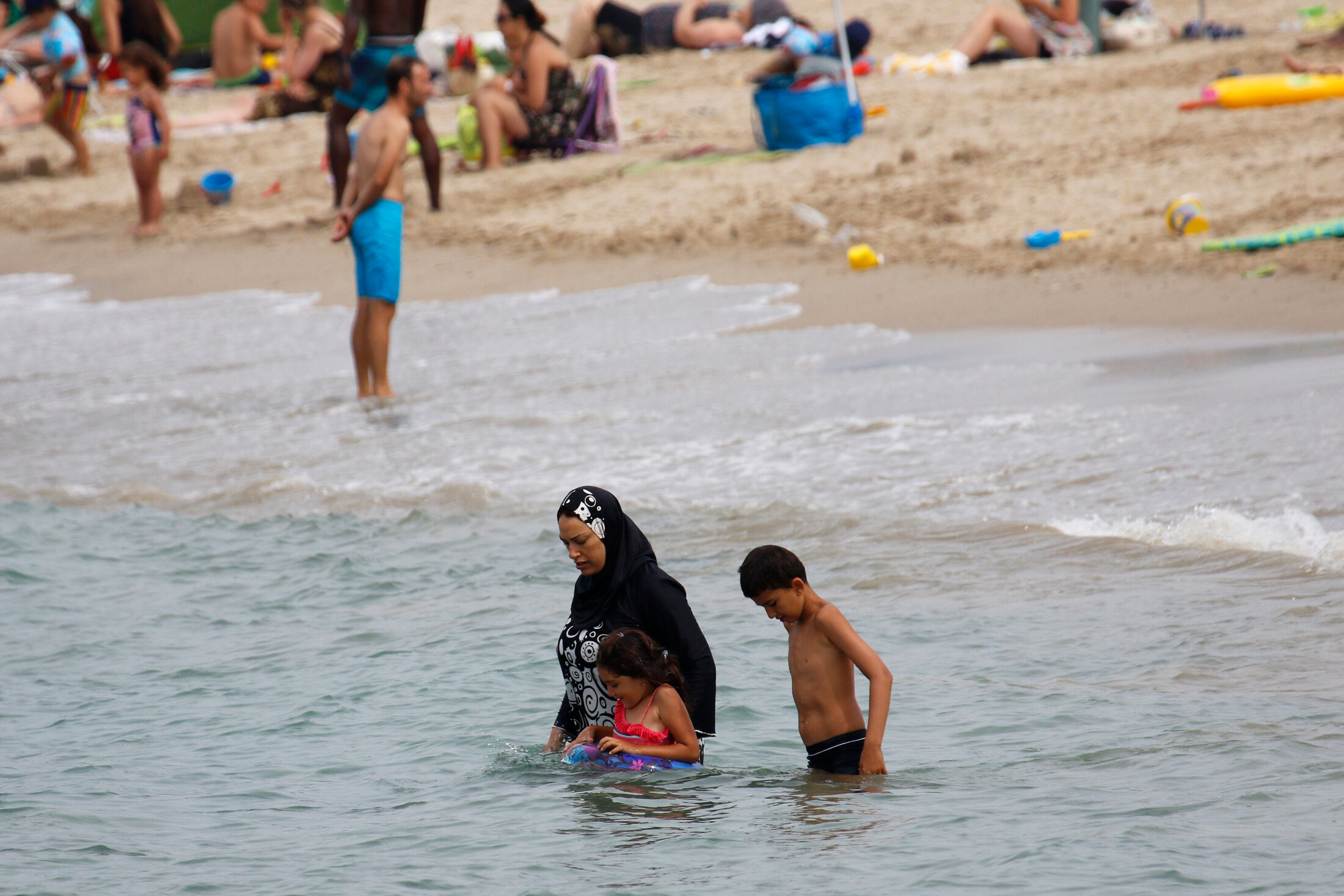
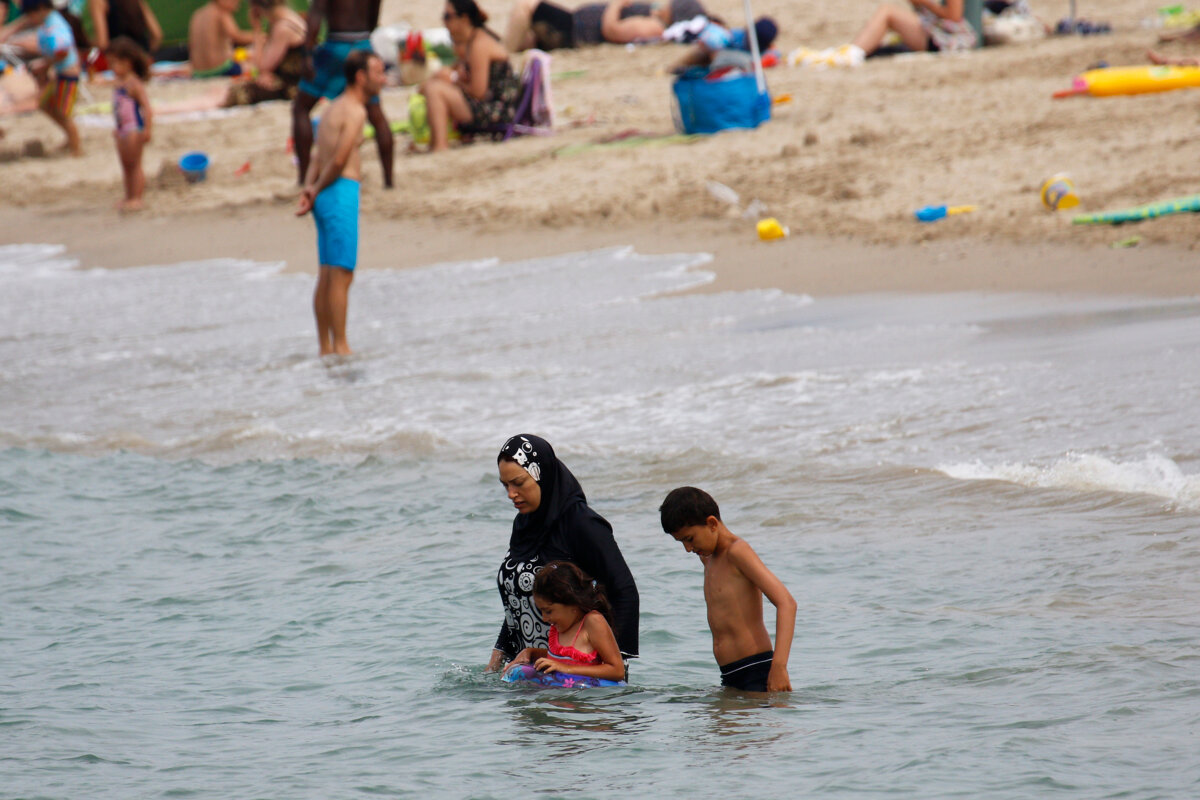
During the public hearing by the Council of State on Thursday (its judgment was delayed until Friday afternoon), the lawyer representing the Villeneuve-Loubet town hall, François Pinatel, admitted that the target behind the somewhat imprecise wording of the decree was the wearing of clothes that manifested signs of religious faith, and notably the burkini, a full-body swimsuit worn by some Muslim women bathers which leaves only the face, feet and hands of the wearer uncovered.
In their ruling, detailed in a six-page document (available here, in French), the three Council of State magistrates, who sat as a collegial panel, in turn call into question the bans imposed by other mayors. Over the past week several incidents have been reported, filmed and photographed of Muslim women wearing headscarves being intercepted by police on beaches where the bans apply, notably Cannes and Nice, in some cases fined and on others summoned to remove their headscarves or leave the beach. As for the suggestion that the bans uphold secularity, beaches are considered a public place in France and as such only the burka, a full body cloak, is banned by a law introduced in 2004.
The magistrates underlined that the role of mayors regarding the municipal police (locally-employed officers with fewer powers than the national police force) is a limited one. “If the mayor is in charge of the maintenance of law and order in his municipality, he must conciliate accomplishing his mission with the respect of freedoms guaranteed by law,” wrote the magistrates in their ruling on Friday.
In his address before the Council of state on Thursday, the Villeneuve-Loubet town hall’s lawyer, François Pinatel , insisted on the manner in which clothing displaying religious faith placed a threat to public order, and more precisely that the ban was a “preventive measure”. Asked by one of three presiding magistrates whether any such incident had been recorded, Pinated answered that none had. In their ruling, the magistrates concluded that “no element” was presented to the hearing which led to conclude “that such threats would have resulted”.
Pinatel insisted that there was a very particular political and geographic context of the ban in Villeneuve-Loubet, which lies close to Nice where 86 people were killed after a terrorist drove a truck into crowds on the city’s seafront on July 14th. “The elections show that there is in this region a climate of absolute tension,” he said. “The mayors [in the region] are trying to appease by taking preventive measures in order to prevent the situation from degenerating.” But in their ruling on Friday, the magistrates observed that “the emotion and concerns resulting from the terrorist attacks, and notably that committed in Nice on July 14th last, cannot suffice as a legal justification for the contested ban”.
Pïnatel admitted that citing “secularity” in the wording of the ban was “clumsy” and the magistrates confirmed the invalidity of its inclusion, noting that the mayor can only take prohibitive measures in the case of “requirements for proper access to the beach, the safety of bathing and hygiene and decency on the beach”. They concluded: “It is not for the mayor to base himself upon other considerations.”
The decision of the Council of State largely met the plea made at Thursday’s hearing by Patrice Spinosi, lawyer for the French League of Human Rights. He had called on the magistrates to “pacify” and “to be the compass” of a country which “has lost the sense of measure”.
The ruling should in principle serve to end the all other beach bans imposed this month, on condition that they are each separately opposed in local administrative courts.
- Update at 01H00 CET
After the announcement of the ruling the mayor of Villeneuve-Loubet, Lionnel Luca, on Friday evening announced he would maintain the ban. “Far from pacifying, this decision can only heighten the passions and tensions,” said Luca. Only a law can prevent them […] I will move for this as of the [September] return of parliament. Islamisation is advancing in our country, There are those who can rejoice in this, they have won another little step.”
The mayor of Nice has also said the ban would be upheld despite Friday’s ruling.
Ange-Pierre Vivoni, , the socialist mayor of Sisco, a small municipality in northern Corsica close to the town of Bastia, who also announced a “burkini ban” after a brawl between local inhabitants and a family of North African origin on a local beach this month was wrongly reported to be caused by the wearing of a burkini, salso said he would maintain the ban.
“Today, any provocation could light the fuse,” he told TV channel BFM TV. “The tension here is very high.”
French Prime Minister Manuel Valls, who has previously said he “understood” the bans introduced by the mayors, issued a statement via his Facebook account Friday evening saying that the decision by the Council of State “has not exhausted the debate which has opened in our society on the question of the burkini”.
“To denounce the burkini is in no way to question individual freedom,” his statement continued. "The French people […] are waiting for an Islam of its epoch, fully claiming the values of the republic, to win the day. And it is in the first instance for the Muslims of France to construct this, to lead the cultural combat. They are the first to be confronted with the violence of the radical Salafist message.”
-------------------------