


For 11 years, despite the revelations published by Mediapart, despite an investigation by the European Parliament and a subsequent judicial probe launched in France, the story of the far-right Front National party’s alleged embezzlement of European Parliament funds, through a fake jobs scam, remained largely relegated to background noise in France, even as the trial of its leader and party members first opened in Paris in 2024.
But on November 13th 2024, the summing up for the prosecution came as a bombshell, suddenly placing the case under a spotlight of public attention and overnight political controversy. That was because the prosecutors, who called for Marine Le Pen, leader of the Front National at the time of the alleged fraud, to be handed a jail sentence and fine, also recommended she be given a five-year ban from running for public office. As the chosen candidate for her far-right party, now renamed as the Rassemblement National, in the future presidential election, the ban would mean the end of her immediate political ambitions.
Le Pen was, and still is, riding high in opinion surveys and was tipped by many political commentators as a frontrunner in the 2027 presidential election, when Emmanuel Macron is obliged to step down after serving two terms, and without any other obvious favourite having yet emerged. After already running three times for the highest office, coming second in the final rounds of the last two elections, she had never been more hopeful of finally reaching the gates of the Élysée Palace.
All the more so given that earlier in 2024, her party had come comfortably first in European Parliament elections in France, and after the ensuing snap legislative elections called by Emmanuel Macron shortly after, in a gamble he lost, the Rassemblement National was returned as the party with the largest number of seats in France’s parliament.
In a deferred verdict, announced in March 2025, Le Pen was found guilty of misappropriation of public funds in the fake jobs trial, when she was handed a sentence of four years in prison, two suspended – the remainder to be served at home wearing an electronic tag – and a 100,000-euro fine. Crucially, the magistrates also agreed to the prosecutor’s call that she be handed a five-year ban from running for public office, and ruled that it was to be effective immediately.
Her appeal against the verdict and sentence is now being heard in the Paris law courts, along with the appeals of 11 others from among the original 24 defendants from the party (which is also in the dock as a legal entity), in what is in effect a re-trial, due to end on February 12th. The verdict and sentencing of the appeal court magistrates will be announced at an unspecified date between then and June.
Le Pen, as then leader of the Front National, is accused of organising the fraudulent system, whereby National Front members of the European Parliament (MEPs) employed assistants, paid out of the public funds of the parliament, who in reality worked for the party in France, saving it money on its wages bill at the expense of European taxpayers. She is herself accused of directly taking part in the scam through the employment of her own European Parliament assistants, who included the bodyguard and also the butler of her father, National Front founder Jean-Marie Le Pen.
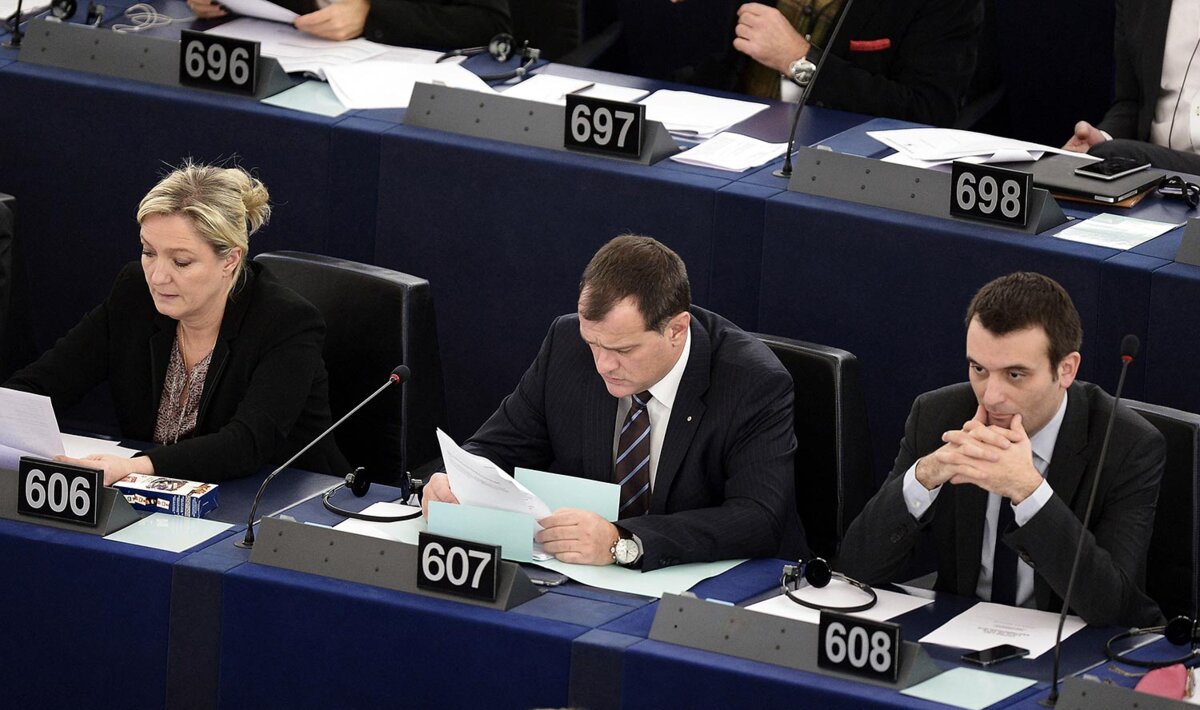
Enlargement : Illustration 1
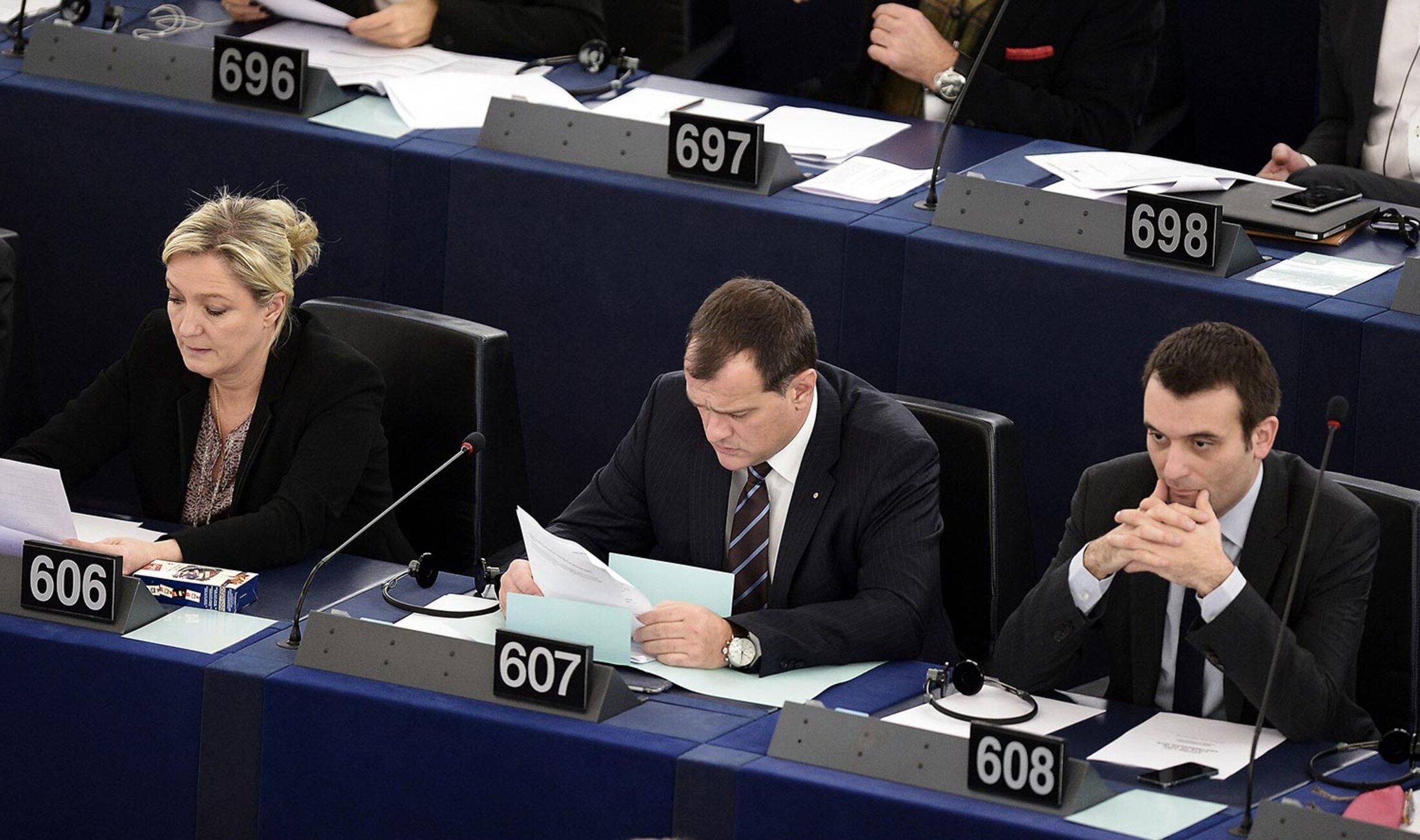
If Le Pen, now aged 57, fails to overturn the five-year ban against her running for office, the consequences for her political ambitions will be disastrous. Not only it will it mean her party’s chairman, Jordan Bardella, 30, will stand in her place as the far-right candidate in 2027, but Le Pen, leader of the Rassemblement National’s parliamentary group, will not be able to stand in any future parliamentary elections (to be held at the latest immediately after the presidential poll) before 2030.
How it all began
Mediapart began investigating the alleged fraud in the summer of 2013, after staff member Ludovic Lamant had taken up his new post that year as its Brussels correspondent, reporting principally on European Union (EU) affairs. It was Mediapart’s first foreign posting, decided after lengthy internal debates as to whether it was an opportune move.
The decision to go ahead was made above all for reasons of better covering the sovereign debt crisis and the ongoing threat to the stability of the euro. But Lamant would soon be drawn to another story.
“When you arrive in Brussels, you can be sucked in by all the institutions, the ministerial meetings, the press briefings of the 27 commissioners, following the national representatives, the countless technical briefings, and even covering at a distance the Court of Justice of the European Union in Luxembourg,” Lamant recalls. “The European Parliament is easier to cover, and yet there are still few journalists to be found there given the importance of European matters that are played out. I was very quickly noticed and identified by those who were shocked at the manner in which the Front National helped itself to European funds.”
It took the new Brussels correspondent several months to finally get hold of an important document he had been informed about. This was a request from the European Parliament sent to Marine Le Pen, then an MEP, for her to explain the employment, as European Parliament assistants, of her party’s two deputy leaders, Louis Aliot (Le Pen’s then personal partner) and Florian Philippot. The pair, who acted as Front National campaign directors in the 2012 presidential and legislative elections, were paid very comfortable salaries from the parliament’s public funds. In the case of Alliot, who was on a part-time contract, this amounted to a gross monthly wage of more than 5,000 euros.
Lamant teamed up with fellow Mediapart journalist Marine Turchi, who covered the Front National in France, before their first revelations were published in the summer of 2013. “But it was headlined ‘Marine Le Pen in a conflict of interest at the European Parliament’, and that was a simplistic aspect of the story,” regrets Turchi today. However, the first line of the report gave a taste of what was to come. “At the Front National, political, financial and family relations are intermixed, just within the law,” it read.
When Le Pen and Aliot sued Mediapart
Mediapart published the contract showing how, since the summer of 2011, Marine Le Pen employed her partner and deputy party leader as a part-time European Parliament assistant, to whom she gave more than 5,000 euros per month paid out of funds provided by EU taxpayers.
At the time, Mediapart was unaware that the contract was part of a far wider system, and the investigation above all highlighted EU regulations in effect since July 2009 which barred MEPs from issuing “contracts providing for the employment or the use of the services of Members' spouses or stable non-marital partners, as defined in Article 58(2), or their parents, children, brothers or sisters”.
While they were happy to present themselves as a couple in a report in French weekly Paris Match and other media, and while they had also bought a house together, Le Pen and Alliot would subsequently deny that they were involved together in any formal relationship.
They sued Mediapart for defamation, but lost (just as every lawsuit the far-right has issued against Mediapart since its creation in 2008 has been unsuccessful).
One year later, Lamant and Turchi studied all the lists of European Parliament assistants, when they discovered not only what appeared to be an established system at the Front National for remunerating both party cadres and underlings, but similar, if less massive, practices by other French parties, including the Parti Socialiste and the conservative UMP party (now renamed Les Républicains).
Mediapart, with the help of its sources, would soon publish more revelations concerning the party, including how Jean-Marie Le Pen received bottles of Champagne and grand cru wines paid out of EU funds, and misuse of funds by Marine Le Pen and her father.
But the case involving parliamentary assistants caused little interest in France, not only because reporting corruption was rarely a headline-grabber in the country, but also because of the specifics of the workings of Brussels. While Lamant was well versed about the behind-the-scenes practices, French political correspondents were in the main uninterested in such activity, and the functioning of EU institutions was regarded by others as obscure. “At the time, there were not as many media specialised on these issues as there are today, and fewer NGOs worked specifically on such subjects,” says Lamant. Scandals in Brussels were apparently not colourful enough. “Yet,” insists Turchi, “European funds are from tax-payers’ money.”
“This money was supposed to create a first-rate European public space, to feed the reflections of [the parliament’s] elected members, and so that they can call upon the best specialists on technical issues who are very often present at a European level [of debate], like on energy and the environment,” adds Lamant. “Not to indirectly fund political entertainment and national campaigns.” He says the confusion was total and “reinforced by what [French radical-left party leader and then-MEP] Jean-Luc Mélenchon said at the time, justifying his absence from Brussels by the fact that he speaks about Europe from France. That argument is very close that of Marine Le Pen, who believes she can exercise her European mandate and use the money that comes with it as she pleases.”
The story of the Front National parliamentary assistants began to gather a wider interest in France only after a judicial investigation was launched, as of when journalists could access, and report on, the progress of the probe. “But from one assistant to the other, it’s very repetitive,” says Turchi. “And Marine Le Pen’s defence is always the same, very political, about a supposed plot [against her]. She doesn’t enter into detail, which doesn’t help for the renewal of coverage.”
The trial opened 11 years after Mediapart’s initial report on the scandal, and was followed, as with the current appeal, by Mediapart’s legal affairs correspondent Michel Deléan. He recalls that it was well covered, “especially on the days when Marine Le Pen appeared, and quite many from the foreign press”. Marine Le Pen regularly gave press briefings, both on and off the record, which drew a lot of journalists, “notably from the television, which needs pictures” says Deléan. “But,” he adds, “the trial received less attention than the book by [Rassemblement National chairman] Jordan Bardella, which was opportunely published at the same moment, in a carefully orchestrated launch.”
Few questions about the trial were put to Bardella at the time, despite his position as head of the party. The lack of journalistic interest, as witnessed over the 11 years, plays into the hands of the Rassemblement National, whose leaders regularly claim that the French public couldn’t care less about the scandal.
When the verdicts were announced last year after the first trial, to the party’s outrage, the sentencing might have appeared excessive for some, given that the scandal had never made front page news until then.
“In April 2025, [Mediapart contributor] Cédric Vallet revealed that a spokesman for Marine Le Pen during [her] 2022 presidential election campaign had also been paid by the European Parliament,” adds Turchi. “In July, the European prosecution services opened an investigation into suspected irregularities of the Rassemblement National group [at the European Parliament] in Strasbourg concerning more than 4 million euros in credits for running costs. Who has heard anything said about these cases?”
-------------------------
- The original French version of this article can be found here.
English version, with some added reporting, by Graham Tearse