


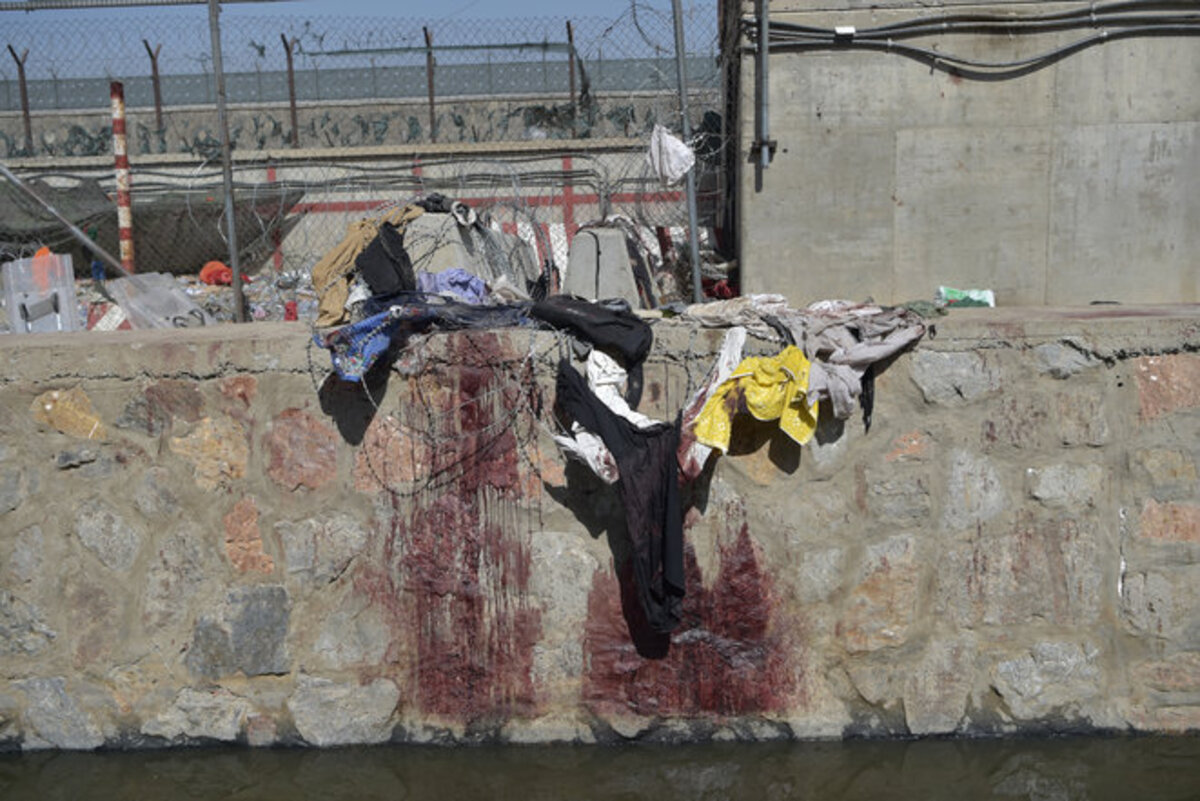
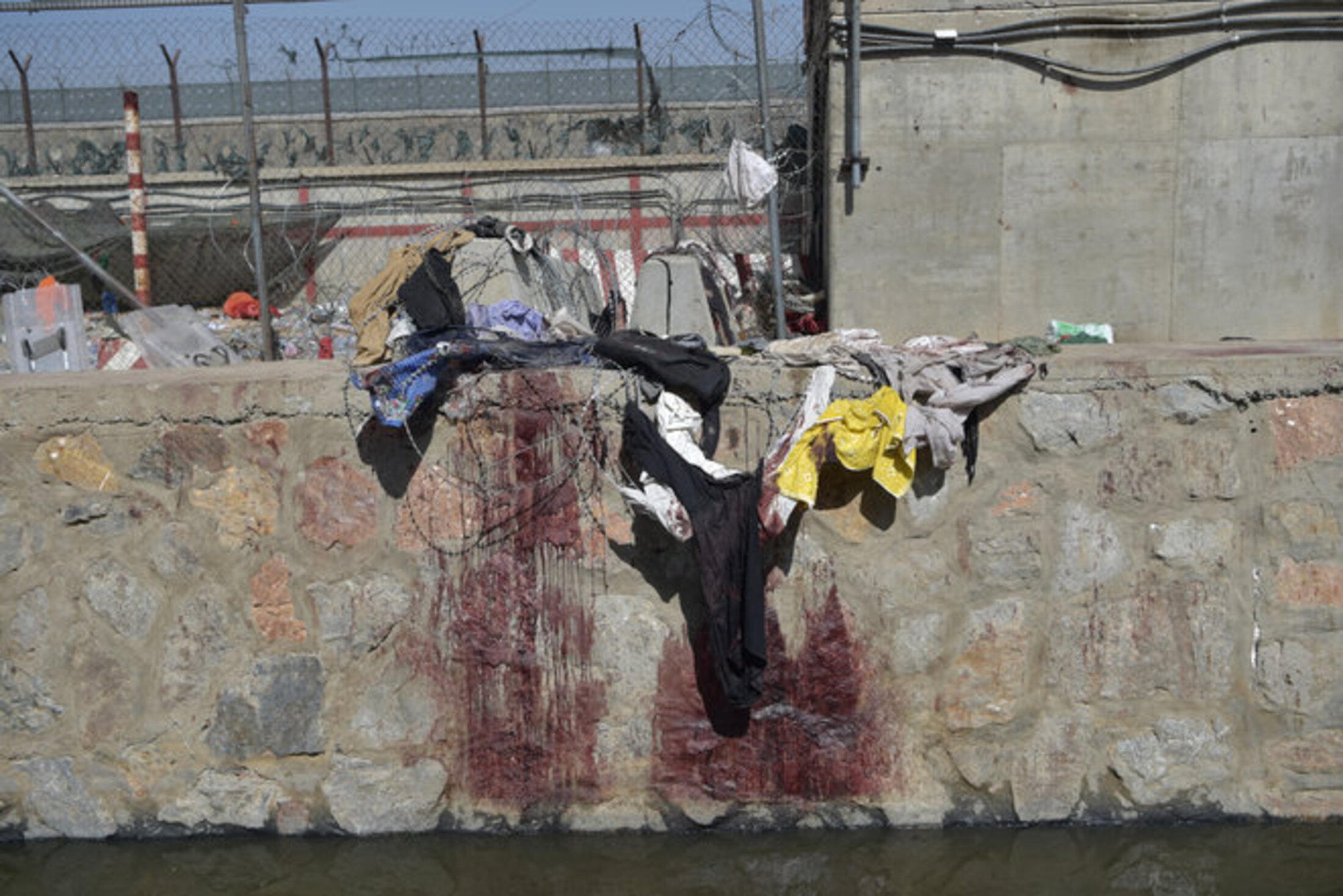
Hitherto largely overshadowed by the Taliban, the Afghan branch of the so-called Islamic State group last week emerged into the forefront of the horror and chaos that has followed the US pull-out from Afghanistan when it claimed responsibility for last Thursday’s suicide bombing among crowds seeking evacuation at Kabul’s international airport, when an estimated 170 people, including 13 US marines, were killed.
On Friday, the US launched a drone attack in the eastern Afghan province of Nangahar against a person described by Washington as an Islamic State (IS) group “planner” , when the targeted individual and another IS member were reportedly killed. The province, which borders Pakistan, was in 2014 the site of one of the first bases for the nascent IS branch in Afghanistan.
On Saturday, four days before the August 31st deadline for the US withdrawal, centred on Kabul’s Hamid Karzai international airport, US President Joe Biden warned that intelligence reports suggested a new attack on the airport was “highly likely”. It was apparently foiled by a second US drone attack on Sunday, this time in Kabul, which successfully targeted a vehicle laden with explosives. “US military forces conducted a self-defence unmanned over-the-horizon airstrike today on a vehicle in Kabul, eliminating an imminent Isis-K threat to Hamid Karzai International airport,” the US military’s central command said in a statement on Sunday afternoon.
“We are confident we successfully hit the target,” it continued. “Significant secondary explosions from the vehicle indicated the presence of a substantial amount of explosive material.”
The events, and previous terrorist attacks before the Taliban’s military victory on August 15th, illustrate the strong presence in the Afghan capital of Wilayat Khorasan, the Afghan branch of IS, more often referred to as IS-K (for Islamic State Khorasan Province).
The IS-K group have in the past avoided claiming responsibility for the most horrific attacks they are believed to have perpetrated. These include the murders, on May 8th this year, of more than 60 people, mostly young schoolgirls, in a series of explosions as pupils were leaving their school in the Dasht-e-Barchi neighbourhood of Kabul. Situated in the west of the capital, the residents of Dasht-e-Barchi are largely from the Hazara community, a minority and mainly Shia Muslim population in Afghanistan.
One year earlier, on May 12th 2020, a maternity hospital run by French NGO Médecins Sans Frontières (Doctors Without Borders) in the same neighbourhood was the target of three gunmen who entered the building and murdered a total of 24 people, mostly mothers and children. Some of the women victims were killed in the delivery room. IS-K is suspected of being behind that attack, as also a suicide bombing in August 2019 at a Shia Muslim marriage in Kabul which left more than 90 people dead and more than another 140 wounded.
The chaos of the past week’s evacuations from Kabul’s Hamid Karzai airport offered IS-K an extraordinary opportunity to cause carnage. What is perhaps surprising is that the jihadists had not struck before last Thursday’s suicide bomber attack amid crowds massed on the airport perimeter, for which IS-K did claim responsibility, and which left an estimated 170 people dead, including around a dozen Taliban and13 US marines. The bombing represented the most deadly single attack against US forces in Afghanistan since 2011.
Enlargement : Illustration 1
While it appears obvious IS-K were looking for an opportunity to make a macabre show of strength since its rivals, the Taliban, overran Kabul on August 15th, the airport attack raises a number of questions. Notably among these is how the group could have maintained such an effective sleeper cell in the capital despite the killings of its principal leaders and the many casualties it suffered over recent years in fighting with the Taliban, US and former Afghan forces. These had left it largely eliminated in the Nangarhar and Kunar provinces where it had once been very active.
A report published in July by the UN Security Council estimated the ranks of IS-K to number between 500 and several thousand. In a recent post on Twitter, the former First Vice-President of Afghanistan, Amrullah Saleh, who since August 17th has found refuge in the Panjshir Valley in north-central Afghanistan, reiterated previous accusations that the IS-K has close links with the “Haqqani Network”, so-called after the name of its leader, and which is an offshoot of the Taliban movement.
The Haqqani Network was behind some of the bloodiest attacks of recent years in Kabul, including the triggering on May 31st 2017 of a truck filled with explosives in a neighbourhood that was home to foreign embassies, and which left more than 150 people dead and more than 400 others wounded.
According to Saleh, who once headed the Afghan intelligence services, IS-K and the Haqqani Network shared weapons caches.
The creation of IS-K goes back to 2014. According to NATO estimates, at that time it had between 600-700 fighters spread over districts of Nangarhar Province, bordering Pakistan in east Afghanistan, and another 200-300 in the neighbouring province of Kunar. But the organisation would also become active, the following year, in the north-east of the country.
At its origins, the IS branch in Afghanistan was created from a split within the Pakistani Taliban movement, the Tehrik-i-Taliban Pakistan (TTP). The TTP, an jihadist umbrella movement of around 20 organisations of Wahhabi doctrine affiliated to al-Qaeda networks, targeted all agencies representing the state, including the police, army, justice courts and other administrative bodies.
In January 2014, the Pakistani government, then led by prime minister Nawaz Sharif, engaged in a process of negotiations with the TTP to put an end to the recurrent bloody attacks led by the terrorist group from its bases in the tribal areas of the Pakistani-Afghan border region. But TTP hardliners opposed the talks and created a breakaway group, the Ahrar-ul-Hind (roughly translated as “Liberation of India”). In March that year, the TTP dissidents announced they had executed 24 Pakistani soldiers held captive since 2010.
Ahrar-ul-Hind subsequently renamed itself Jamaat-ul-Ahrar (for “Assembly for freedom”). The two names testified to the aim of the insurgents to open terrorist fronts in India, which had already been targeted by Pakistani-based Islamists in the 2008 Mumbai terrorist attacks which left 175 dead, including nine terrorists, and more than 300 wounded. Jamaat-ul-Ahrar developed rapidly in certain tribal zones along the Pakistani-Afghan border region, and in January 2015 it announced its allegiance with the Islamic State group, which by then controlled swathes of territory in Syria and Iraq.
It was when the Pakistani army subsequently launched a major offensive against the jihadists in the tribal zones that the Jaamat-ul-Ahrar and its affiliates crossed into Afghanistan, leading to the emergence of the IS in the country.
The group began by taking control of foothills in the Spïn Ghar (“white mountain” in Pashto) mountain range which overlooks the district of Achin in Nangarhar Province, ousting the traditional Taliban who had had a long and solid base there.
In Achen District, the TTP dissidents would profit from a long territorial conflict between the Sepai and the Ali Sher Khel tribes. The US had made the mistake of arming the Sepai to fight the Taliban, not realising that they would use the arms against the Ali Sher Khel. When this became apparent, the US halted the weapons supplies, infuriating the Sepai who then turned to the Jaamat-ul-Ahrar for aid.
The jihadists went about buying the loyalty of tribal leaders and offering to pay tribesmen up to 600 dollars per month to join their ranks, which they did in large numbers. The new name for the IS group in Afghanistan, Wilayat Khorasan, is that of a former region defined by 11th-century Arab geographers and which included what are now parts of Afghanistan, Pakistan, Iran and other areas of Central Asia.
The Wilayat Khorasan, or IS-K, were reinforced by members of the Islamic Movement of Uzbekistan (IMU) which had set up a base in Afghanistan at the end of the 1990s. Established in the north-east of the country, and bolstered by Islamic militants from Central Asia, the IMU proved to be a particularly ferocious enemy for the Afghan army. Although it had allied itself with al-Qaeda, some of its members left in 2015 to join the IS group.
The more the IS movement developed, the more it became the enemy of the Taliban, notably because it threatened the latter’s supply routes with Pakistan. The two became involved in increasing fighting, which most often turned to the advantage of the more numerous and better-equipped Taliban.
But now, IS-K, although depleted and largely confined to Kabul, may yet benefit from the support of those Taliban who regard the negotiations between their leaders and the US, which led to the agreement reached in February 2020 for the American pull-out, as a betrayal of the jihadist cause.
-------------------------
- The original French version of this report can be found here.
This updated English version by Graham Tearse