


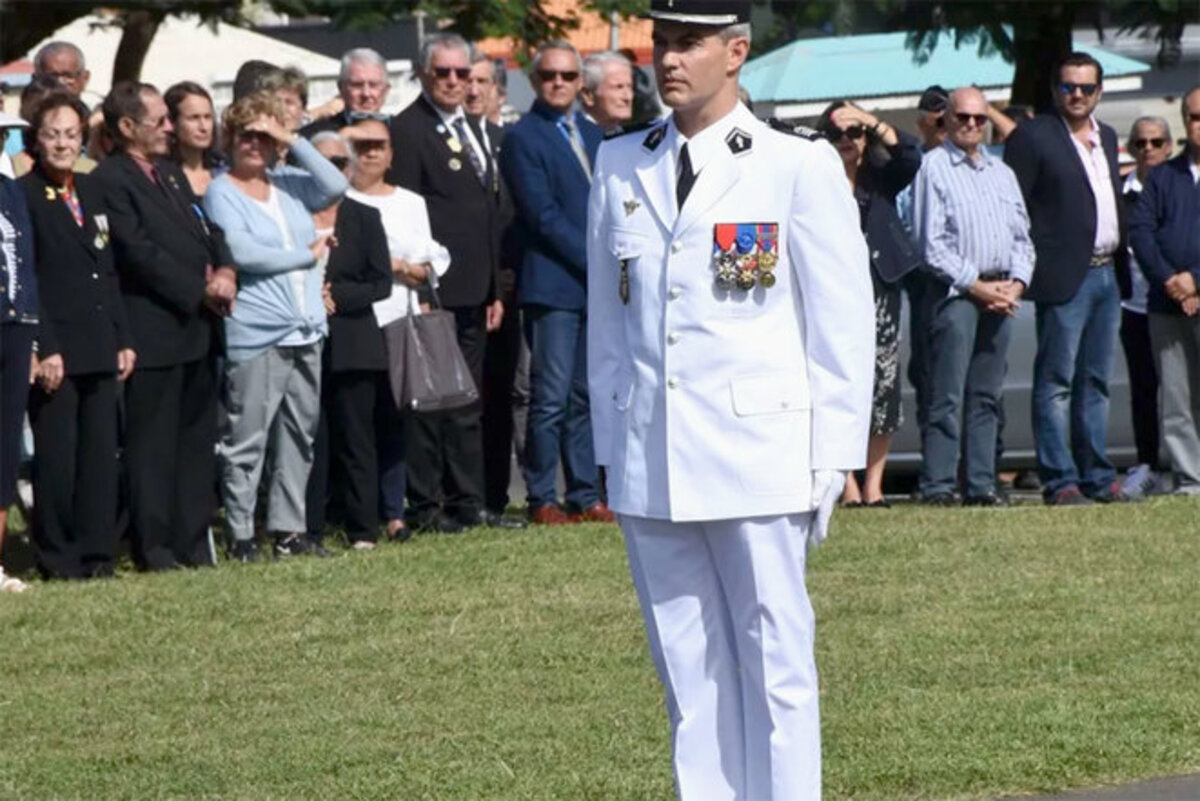
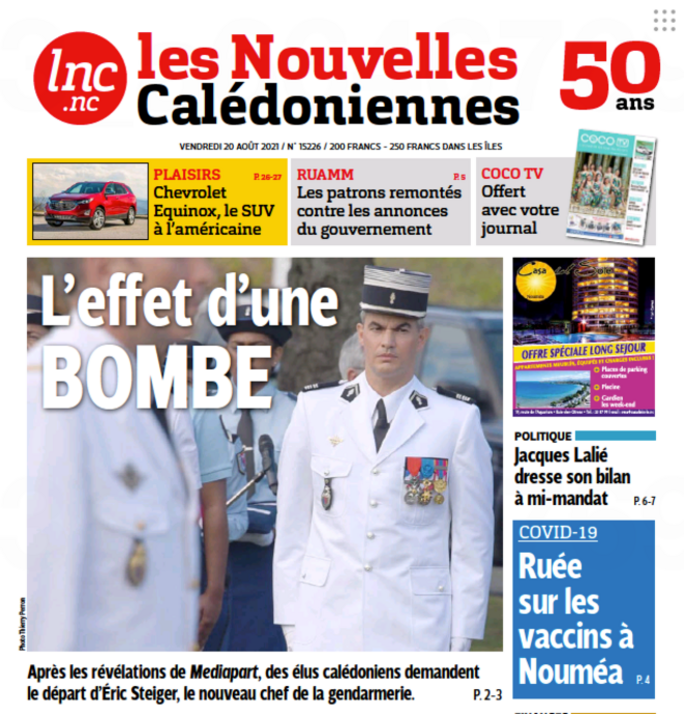
The newly appointed head of the gendarmerie in France’s South Pacific territory of New Caledonia was forced to give up his post last Friday following Mediapart’s revelations that he had been convicted in 2020 for acts of violence against his wife.
Colonel Éric Steiger received a six-month suspended prison sentence after he was found guilty by a Paris court in February 2020 of committing physical and psychological violence against his wife over the period between November 2017 and June 2018. After he appealed the sentence, it was reduced on May 28th this year to a fine of 6,000 euros. Because he did not appeal that ruling, the sentence is regarded as being definitive.
Steiger,48, was appointed by his hierarchy despite their knowledge of his conviction, for which he was never the subject of disciplinary measures.
Enlargement : Illustration 1
According to a study published in 2017 by France’s economic, social and environmental council, the CESE, a public body that advises the government and parliamentarians on policy making, a survey of women in New Caledonia found that 19% of respondents said they had been the victims of physical assault over the previous 12 months, compared to 2.3% of women respondents in an identical survey carried out in mainland France.
Enlargement : Illustration 2
Following Mediapart’s revelations, first published on August 18th (in French here), French interior minister Gérald Darmanin posted a brief statement on Twitter last Friday announcing that, after he had asked the director-general of France’s gendarmerie to hold discussions with Steiger, the latter had “requested to be relieved of his duties in New Caledonia”.
On Tuesday morning, in an interview with public radio France Info, the minister appeared to defend Steiger, while also targeting the colonel’s wife. Arguing that Steiger “should no doubt not remain in [his] post given the cabal he is subjected to”, he said that “I am not for witch-hunts and I detest man- or woman-hunts”.
In an interview published by French daily Le Parisien on August 1st, Darmanin announced that any police officer or gendarme who had been definitively convicted of domestic violence – and without detailing whether this concerned only those handed a prison sentence – should be removed from contact with the public while awaiting a decision on disciplinary action.
But on Tuesday, he said his past instructions were that “all police officers and gendarmes who had been given prison sentences or suspended prison sentences for domestic violence” should not take up posts of responsibility, and insisted that Steiger had not received a definitive jail sentence (although in fact his conviction is definitive).
"La justice n'a pas condamné le colonel Steiger de façon définitive. Je ne suis pas pour les chasses aux sorcières", affirme le ministre de l'Intérieur Gérald Darmanin pic.twitter.com/pmqDdWzmqu
— franceinfo (@franceinfo) August 24, 2021
Above: public radio station France Info's post on Twitter relaying its interview on Tuesday with interior minister Gérald Darmanin.
“His [Éric Steiger's] spouse – his ex-spouse – was also convicted, which had not, I believe, been underlined by the journal Mediapart,” Darmanin told France Info. That statement was totally false.
In Mediapart’s first report on the case, published last Wednesday, Steiger’s former wife was interviewed at length, and it was detailed that soon after she filed her complaint against him for violence “Éric Steiger also filed a complaint, claiming he was the victim of violence by his wife”. Mediapart reported that at the end of the first court case, she “was found guilty of violence”, but the sentence was overturned on appeal, when the case against her was thrown out. Contrary to the minister’s claims, she is therefore innocent of the charges brought against her.
“My fault was to have struggled back when he hit me,” Sophie (not her real name), 49, told Mediapart. “Once, I caused him to fall from his seat, and another time I slapped him.” The couple, who married in 1997, have three children together. One of their daughters gave a statement confirming Sophie’s accounts of the violence she endured.
In their ruling in May this year, when Steiger’s sentence was reduced to a fine, the presiding magistrates took into consideration the colonel’s admission of committing violence against his wife: “Going back on his previous position of denial, Éric Steiger declared that he was conscious that his behaviour towards his wife had been violent and he wanted to recognise his responsibility,” they wrote. “[…] He was able to say today that it was his incapacity to talk with his wife that led to his violent reactions.”
Questioned last week by Mediapart, before Steiger’s resignation, about his promotion as chief of the gendarmerie in New Caledonia, and why he had never been disciplined over his conviction, the Directorate General of the French gendarmerie (the DGGN), its senior management body, issued a statement saying the case involved the “painful context of the couple’s separation after 20 years of life together”.
“The officer concerned kept his hierarchy informed at each stage of the [legal] procedures,” it added. “A definitive judicial decision came on May 28th 2021. The decision was not an obstacle against the nomination by the DGGN of the person concerned to his current post.”
Meanwhile, questions are also raised as to why no action was taken by junior minister Marlène Schiappa, in charge of citizenship issues at the interior ministry, after she was alerted to Steiger’s conviction by his former wife in a letter dated October 5th last year. The letter was sent to Schiappa following Steiger’s appointment in August 2020 as the gendarmerie’s second-in-command in New Caledonia, 11 months before his subsequent promotion as chief.
At the time, the colonel’s appeal against his suspended prison sentence had not been heard. In her letter, obtained by Mediapart, Steiger’s ex-wife asked how it was possible that “the gendarmerie could close its eyes to the suspended sentence of six months in prison […] and carry out a total code of silence over this situation?”.
“How could such a paradox come about, given all the projects on the initiative of the gendarmerie against domestic violence?” she continued. “[…] Such a distinction between private life and public professional life is incomprehensible, notably with regard to the importance of public relations in the work of Éric Steiger.”
Steiger’s former wife also underlined Schiappa’s “engagement and success” in defending women’s rights “and notably against domestic violence”, referring to the junior minister’s high profile in promoting President Emmanuel Macron’s avowed aim of making violence against women a “major national cause” during his presidential term.
Schiappa never replied to the letter, nor did she make contact after Steiger was sentenced in May 2020. While the junior minister is notably active with posts on social media, her only public reaction to his resignation on Friday was to relay Darmanin’s message on Twitter.
-------------------------
- This article is an abridged compilation of three Mediapart reports in French, available here, here and here.
English version by Graham Tearse