


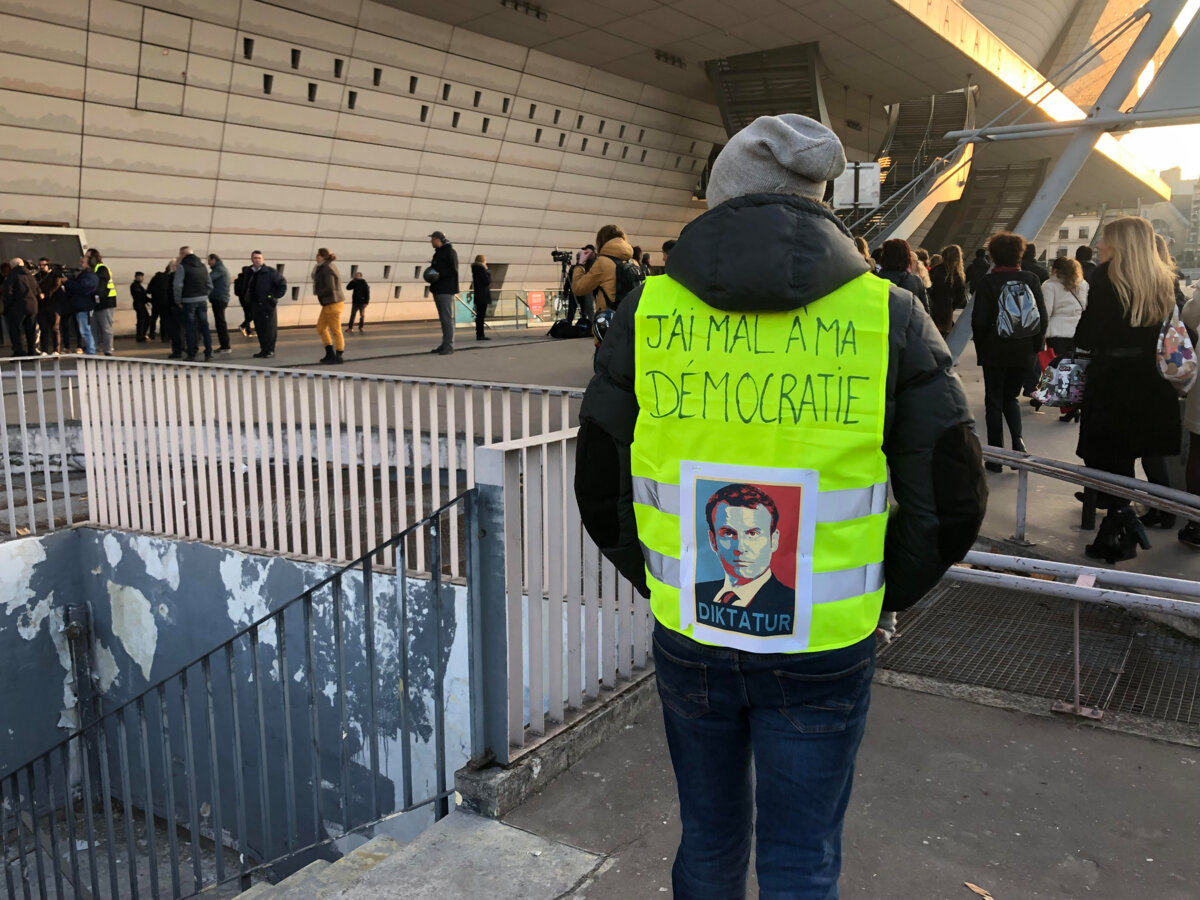
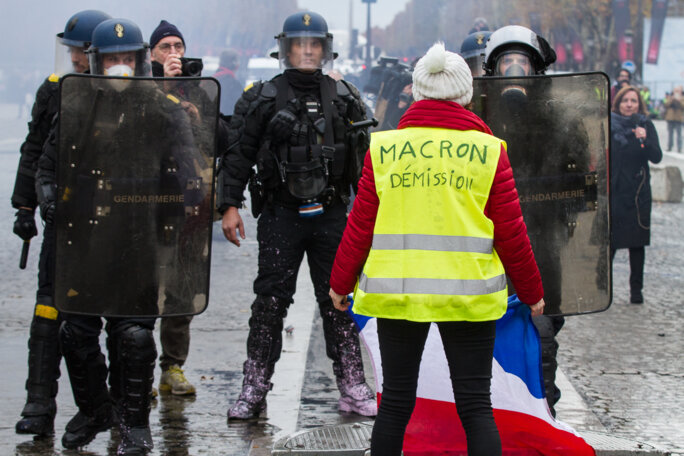
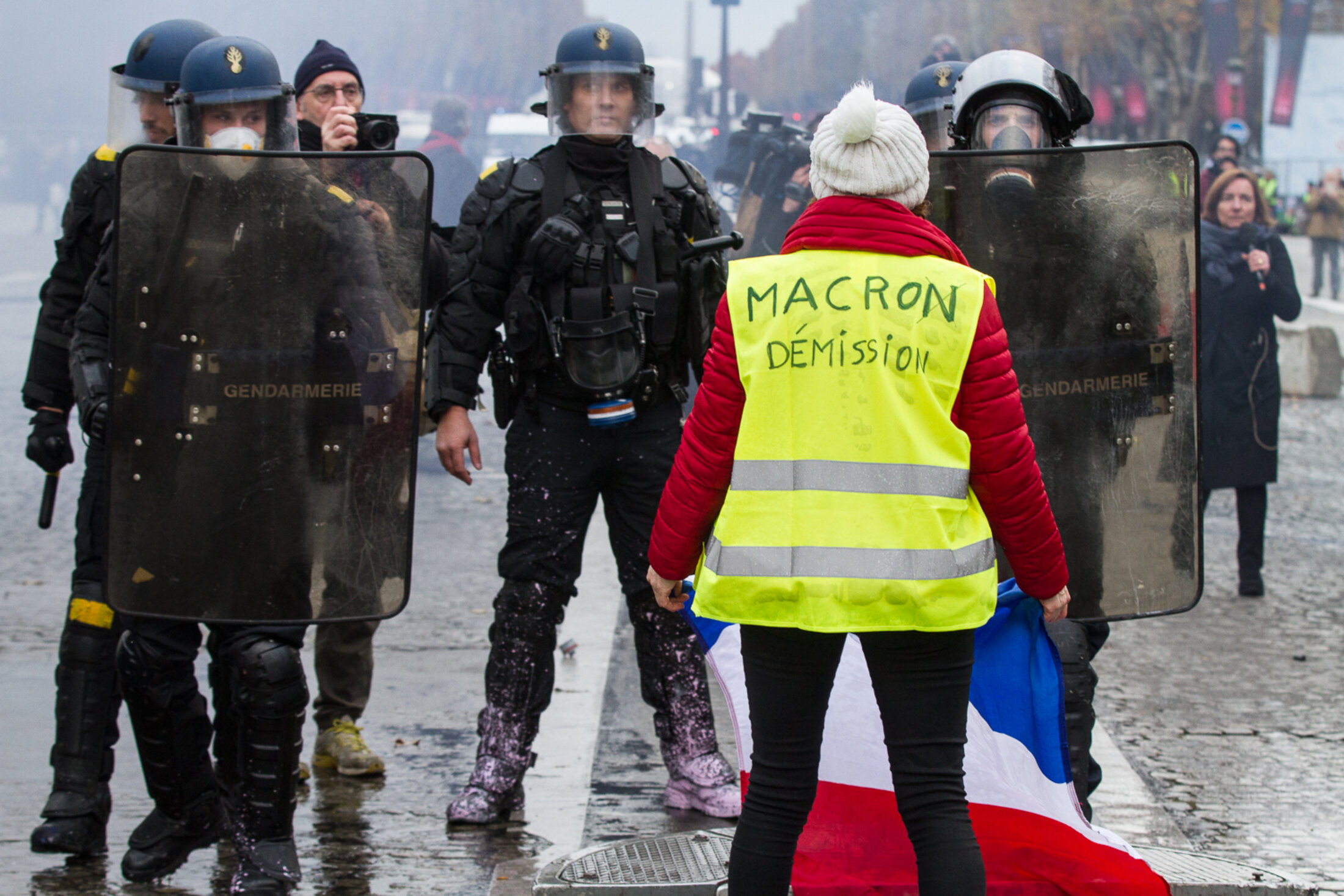
This weekend will witness 'Act 3' of the 'gilets jaunes' or yellow hi-vis vest protests over fuel tax rises when demonstrators descend on the centre of Paris for the third week in a row. But will this movement, onethat has no leader, structure or detailed coherent programme, be able to make a decisive breakthrough?
President Emmanuel Macron's response to the protests last week failed to convince the gilets jaunes and though the minister in charge of energy transition, François de Rugy, met some of the movement's representatives he made it clear that it was not the aim of green taxes to “resolve inequalities”. One of the key claims of the protesters is that hikes in green fuel taxes disproportionately hit those on low incomes and in rural areas where there is little or no public transport. As a result the gilets jaunes have called another gathering on the Champs-Élysées on Saturday December 1st, following the protests last week that led to scenes of violence.
Meanwhile more traditional protest groups are joining in this social movement. Trade unionists, anti-racist and groups on the Left, and students are taking part in their own day of demonstrations in Paris this weekend.
At the moment it is impossible to know whether the various protests will stay separate or will merge in any way to form a more united social movement.
Enlargement : Illustration 1
For clues as to how the protests might pan out, it is worth considering the situation in the oil and fuel sector. For several days the majority of refineries run by oil giant Total have been on strike, as have oil depots. In theory this should be a great boost for the gilets jaunes protesters, who have called for the economy to be hit to ratchet up their protest. There is now concern about fuel stations running dry, something which which would be a powerful symbol for a movement which is based on rejecting rises in fuel taxes.
Yet the refinery staff and the gilets jaunes protesters eye each other with suspicion, each fearing the other will trying to exploit the other's actions for their own ends. The majority trade union at Total, the CGT, had been warning since October – before the fuel tax protests – that they might go on strike. They fear that the labour reforms decreed by President Emmanuel Macron's government have undetermined their collective agreement with employees in the oil sector.
In particular the unions fear that the two major players in the industry, Total and ExxonMobil, want to reduce staff bonuses, which make up a significant part of their salary. Under the new government rules it has been possible since January 1st, 2018, for a company to offer a local deal that is less advantageous that the general deal offered by the sector to which it belongs. On Thursday November 22nd, after a day of failed negotiations with representatives from the oil industry body the Union Française des Industries Pétrolières, the CGT trade union and colleagues from fellow union Force Ouvrière (FO), made their position official and called on staff in the oil sector to “intensify the strike” and stop arrivals, deliveries, and production and distribution. Many observers saw this action as a way of ratcheting up the pressure, coming as it did just a few days after the start of the gilets jaunes protests.
“We didn't wait for the gilets jaunes,” insists however Patrick Bernado, the CGT official from the Grandpuits refinery 50 or so kilometres south-east of Paris. “Personally I do not really agree with [the gilets jaunes protesters]: to tackle the problem of consumer spending power I'm in favour of a rise in wages not a reduction in taxes,” he says. However, he accepts that some members of his union have been active in the citizens movement.
In fact dialogue between the two groups has not been easy. “The gilets jaunes have been on the roundabout leading to the refinery for days,” says Fabien Cros, a CGT official at the Mède refinery near Marseille in the south of France. “But it's only now that they're discovering that we're on strike! We speak to each other but they don't really listen.”
In the northern coastal town of Le Havre, workers voted last Monday, November 26th, to down tools at the Total refinery. The union general assembly that voted for this action was held near the Gonfreville-l'Orcher factory on the very same roundabout where local protesters have been gathering. “There were speakers and 200 people were present,” says Thierry Dufresne, a CGT coordinator at Total, describing the scene. “Many gilets jaunes actually discovered what a [general assembly] was, what the CGT was!” This highlights a cultural difference. Some of the citizens movement protesters are against anything that resembles an 'institution' and dialogue between then and the union remains difficult.
The oil workers also admit they feel a certain weariness about striking on behalf of “others”, with recent social conflicts leaving a bitter a taste. “In 2016, at the time of the El Khomri law [editor's note a reform of employment law under President François Hollande], we were supposed to be on an inter-professional strike,” recalls Thierry Dufresne. “The refinery workers were the ones who were highlighted the most and the most affected. But you can't make a government yield on your own. Real paralysis isn't pallet fires on roundabouts it's stopping work in companies!” The unions are also opposed to getting caught up in a catch-all protest, of wearing themselves down and thus losing out in their collective bargaining as a result. “It's a bit mean, but for once we're thinking about ourselves,” says Patrick Bernado.
The question of whether to associate oneself with the broad range of demands made by the gilets jaunes goes beyond those sectors which are able to block the country's economy, such as oil workers. It is also a key issue in relation to this Saturday's protests. The CGT, for example, had long scheduled a march against unemployment and lack of job security for this date. The march is planned to start at 2pm in Place de la Répyblique. At the moment there are no plans to head to the Champs-Élysées where the gilets jaunes protesters will be gathering. And its appeal on November 19th for people to take part the CGT rejected any link with “those peddling xenophobic, racist or homophobic ideas”. But as Mediapart has already noted (read here in French) the union is oaying very close attention to the wide-ranging citizens movement that has sprung up across France and which has attracted a number of its own members.
It is also not clear what will happen in the many provincial town and cities where protests will take place this weekend and which could see different marches crossing paths or even heading for the same target, for example the local prefectures which are representatives of the central state. In Toulouse in south-west France the CGT, allied with the FSU and Solidaires unions, is even calling on the gilets jaunes to join them. The CGT is thus seeking a broad mix of participation, calling on “all citizens, those in work and pensioners to join together in demonstrations for the jobless to demand immediate and precise responses on the part of the government and employers”. This call to action has not pleased everyone. The new boss of the FO trade union, Yves Veyrier, criticised in Les Echos newspaper an appeal that he said was “addressed to the citizens and not just to workers” meaning therefore it was outside of the “trade union framework”.
'Doing it without us is doing it against us'
Other trade unionists have clearly decided not to go it alone. The 'social front' that brings together in particular members from the Sud and CGT unions and members of the anti-capitalist Nouveau Parti Anticapitaliste (NPA) will be out on the streets, as they have been since the start of the demonstrations. The union Sud-Soldaires has also decided to be present “everywhere”. It is calling people to come en masse to all the protests planned for this Saturday, including the gilets jaunes one, in the name of “social justice , tax justice and energy transition” and equality.
“We wanted to come together in the spring, that didn't take off, but perhaps the terrain is more fertile now,” says Bruno Poncet, official in charge of rail workers at the Sud-Rail union. Their march will leave from the Saint-Lazaire railway station in Paris at 1pm and head for the Champs-Élysées accompanied by workers who have been staging daily 'inter-station' protests at the Gare du Nord station against the planned reforms of rail operator SNCF. Also taking part in that march will be members of the Action Antifasciste Paris-Banlieue group and the Comité Adama organisation, name after Adama Traoré, a 24 year-old man who was found dead in a gendarmerie north of Paris in 2016, in circumstances which remain unclear.
Enlargement : Illustration 2
The Comité Adama, which is supported by writer Édouard Louis, is calling on people to demonstrate alongside the gilets jaunes protesters, as they also called on people to join another popular protest back in May. “Doing it without us is doing it against us,” says Adama's sister Assa Traoré, who heads the committee, and which also brought together thousands of demonstrators against police violence on July 22nd, at Beaumont-sur-Oise north of Paris.
“The gilets jaunes are protesting so they can get by, so they can eat. The residents of working class areas are going to demonstrate so they can get by, but also to have the right to breathe,” she says in reference to her brother. Gendarmes concerned with her brother's death were questioned for the first time on Tuesday and Wednesday November 27th and 28th. “We're not going to follow events, we will lead them,” says Assa Traoré.
Another leading figure in the group, Yousef Brakni, says that working class areas should have their place in Saturday's protests. “We're not inviting ourselves, we're not even 'alongside' this movement, it's us. We have to take our place,” he adds. He sets out the similarities between the grievances of the gilets jaunes and the residents of working class area. “We live in areas which are cut off, which have been allowed to deteriorate, we have to travel kilometres to get to work, it takes hours, the public services have disappeared, we are hit directly by the effects of liberalism, we live in accommodation that is sometimes like that from the 19th century.”
On top of this long list Yousef Brakni adds “the specific issue of institutional racism and state repression”. He says he is proud to have got some activists on the Left to adopt a position on these questions, something they have been reluctant to do in the past. For him it is crucial that they do not allow the extreme right to “infiltrate” the protests. “If the gilets jaunes really become racist we'll have to fight two enemies, them and Macron,” Brakni says.
A similar but not identical approach is being taken by the Rosa Parks collective, which is calling on “all victims of racism, all those who can't take racism or neo-liberal policies any more” to demonstrate in Place de la Nation in Paris at 2pm. For the group it is a way of seeking to re-establish itself as a powerful force of protest.
The planned action by the Rosa Parks collective has been scheduled for some time and is supported by the CGT and other unions such as Solidaires and the FSUI. “Trade union members, we are firmly convinced that an injustice done to one of us is an injustice against everyone. Whatever your skin colour. Whatever your origins or religion, real or assumed,” the unions say in a text supporting the march.
It is fair to say, however, that the unions have not always felt supported by the wider population. In the spring of 2018 railway workers made constant appeals for the public to support them during their four-month industrial action, especially over their attempts to defend the public rail service and protect small lines. The lack of response they received then is still remembered. “The rail workers felt a bit alone then,” says Bruno Poncet from Sud Rail. “But I think we can't let the anger that is being expressed today pass us by, while of course not interfering with the gilets jaunes' independence.”
A similar sentiment was expressed during the Nuit Debout protests in 2016 in which economist Frédéric Lordon and journalist François Ruffin, now an MP for the radical left La France Insoumise party, played prominent roles. Their friends, who organised the Fête à Macron protest on May 5th this year, this week organised another gathering at the Place de la République in central Paris. “We feel that it's a key moment,” they said in a statement. “That the time has come. The oligarchy represented by Macron has doubts, is hesitating ….At this time we are all wondering what do do. Should we trying to bring progressive forces into the battle?”

Two of the main student representative bodies, who have also called for protest on Saturday, have been asking themselves the same question. They are protesting against plans announced by prime minister Édouard Philippe to increase enrolment fees from the next academic year for students coming from countries outside the European Union. These fees will jump from 170 euros today to 2,770 euros, while for masters and PhD students the cost will go from 240 euros to 3,770 euros.
There have been protests in several universities such as Poitiers in central western France where the university authorities themselves are opposed to the plans. Yet so far they have not linked up with the gilets jaunes protests. Lilâ Le Bas, president of the UNEF student union, says they do not want their demands to be “diluted” by other grievances and so they do not want to ally themselves to another movement.
Thomas Martin-Dimichele, vice-president of the FAGE student union agrees and says it is “out of the question” for them to join the social movement that has erupted in the last three weeks. “We want to fight against this sector-based measure which is going to hurt a category of vulnerable students and which could later be extended to other categories,” he says.
No one can be sure what form this variety of different protests on Saturday will ultimately end up taking, but the sheer diversity of groups demonstrating on the same day is unprecedented. As the journalist Olivier Cyran, co-author of the book 'Boulots de merde!' ('Crap Jobs!'), tweeted ironically: “The 'gilets jaunes' are the McDonald's of the social movement: you come as you are. The extreme right or [radical left La France] Insoumise, immigrant hunters or protesters who don't shy away from trouble, a boss or poor person, a prison guard or future prisoner, cop or victim of police violence, ketchup or mayonnaise.”
---------------------------------------------------------------------------------------
- The French version of this article can be found here.
English version by Michael Streeter